Deposit Limits and Self-Exclusion Tools for NBA Bettors
NBA responsible gambling tools are the part of the betting infrastructure I tell every new punter to set up before they place a single wager. The standard advice is to…

Exploit NBA quarter and half betting markets at UK sportsbooks. Compare first-quarter prices, apply halftime strategies, and secure your welcome bonus.
 Available in US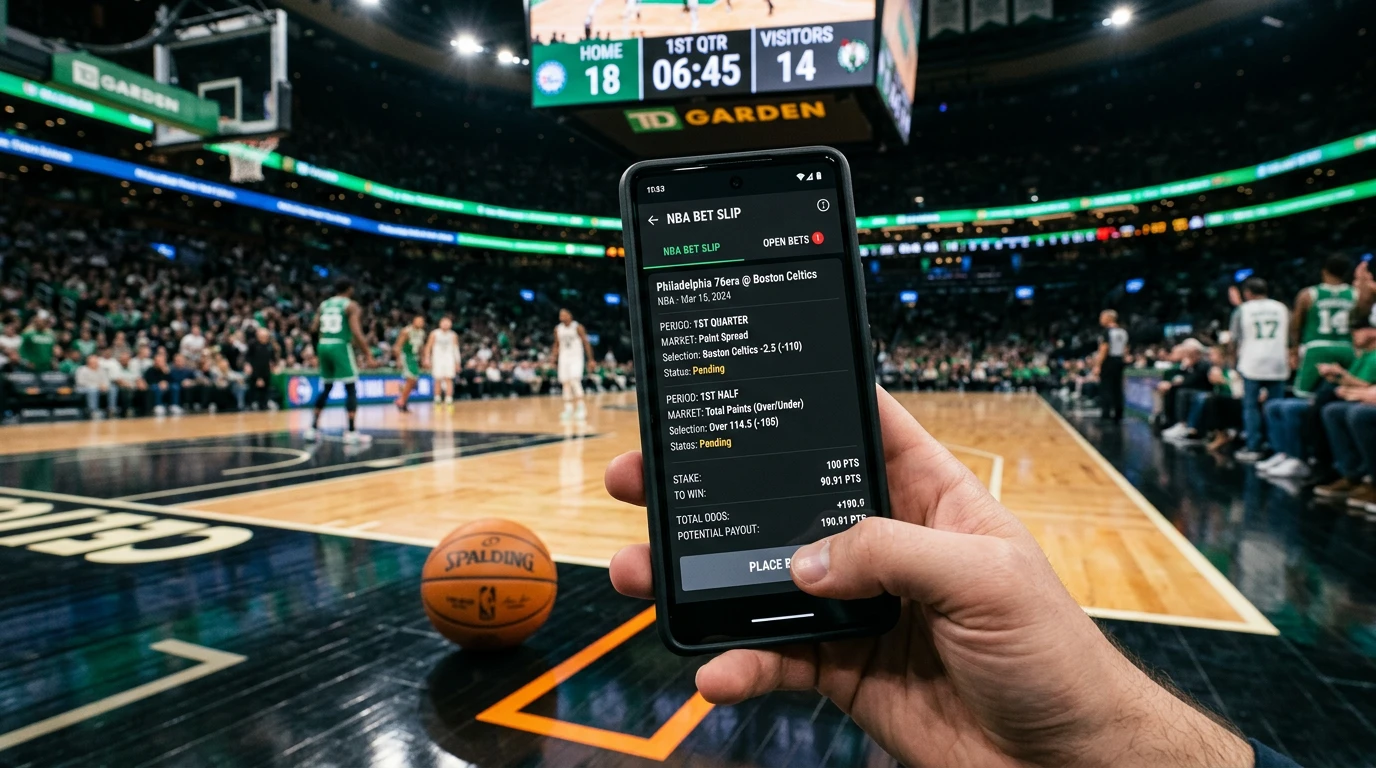
Table of Contents
I lost a quarter-spread bet on a Heat-Knicks game by half a point in the final possession of the third quarter, and as I closed the bet slip I caught myself thinking “well, at least overtime won’t matter.” The thought stuck because so many UK punters arrive at quarter and half markets carrying full-game-spread assumptions. NBA period betting has its own settlement rules, its own price patterns, and its own way of rewarding people who read the schedule and the rotation rather than the box score. It’s a market worth knowing well, not least because it’s where some of the most predictable edges in basketball live.
Quarter and half markets are a subset of the broader live-and-pre-match NBA menu. You can bet the spread, the total, and the moneyline for any single quarter, for the first or second half independently, and in many cases the full first half before tip-off. UK bookmakers usually price these as 10/11 two-way markets with slightly wider holds than the full-game equivalents, because liquidity is thinner and the operator carries more model risk on a 12-minute window than on a 48-minute one.
Here’s the rule that catches almost every new punter – for quarter and half markets, the period is defined by regulation play only. Twelve minutes of game clock. Forty-eight minutes for the full game. Overtime is its own creature and lives in a separate market.
That definition has real consequences. A second-half total that gets tied at the buzzer doesn’t roll into overtime; it settles as a push on the bet slip even though the broader game continues. A fourth-quarter moneyline ends when the regulation horn sounds – if the score is level after 48 minutes, the fourth-quarter moneyline is typically void and the stake is refunded. The full-game moneyline keeps running through overtime until somebody wins.
The structural reason for the rule is simple. A quarter market is a price on a closed clock segment, and adding overtime would change the unit of analysis. The bookmaker’s pricing model treats the 12-minute regulation period as a self-contained possession sample, and OT possessions belong to a different distribution. Including them would force the model to price a variable-length window, which is operationally messy and easy to mis-set.
Some UK operators do offer a “Including Overtime” version of certain period markets – usually the second half – alongside the standard “Regulation Only” version. The two are priced very differently. The including-overtime second half has a higher total because OT adds expected points; the regulation-only version sits lower. Read the bet slip wording. If it doesn’t explicitly say overtime is included, assume regulation only.
The first quarter is the most reliably mispriced 12-minute window in NBA betting. I’m cautious about strong claims, but I’ll defend this one: first-quarter lines lean too heavily on full-game expectations and not enough on how teams actually start games.
What drives first-quarter scoring is the starting line-up. Bench scoring doesn’t matter, foul trouble doesn’t matter yet, and pace hasn’t been pulled around by score-state effects. So you’re effectively betting on a pure starters-versus-starters matchup, which is much more stable than a full-game projection that has to account for bench rotations, late-game tactics, and clutch-time slowdowns. The first-quarter spread is essentially a power-ratings exercise between two five-man units.
UK books typically post first-quarter totals around 56.5 for a marquee fixture and 53.5 for a slower matchup, with spreads in the -2.5 to -4.5 band. Mobile bettors – and 78% of all online sports wagers globally were placed via mobile devices in 2024 – tend to hammer the over because basketball “feels” high-scoring early. That creates a recurring under-bias opportunity on lines that have moved up too far from their model number.
The trap is overconfidence on coach tendencies. Coaches who say they want to push pace in the first quarter often don’t, especially on the road. Coaches who say they want to walk it up often discover their guards have different ideas. The actual first-quarter pace data – easily pullable from any public stats site – beats the press-conference narrative almost every time. UK punters who lean on data over rhetoric build small but durable edges on these markets.
The second half is the dirty laboratory of NBA quarter betting, because it’s where coaching decisions actually swing scoring. I find it the most fun market to trade in-play, and also the easiest to get wrong if you ignore rotation patterns.
Second-half spreads usually open about 30 seconds after halftime, once the bookmaker’s model has digested the first half. They get priced around the projected third-and-fourth-quarter scoring gap, then react to whichever side held the ball when the half ended. If the favourite went into the locker room down by six, the second-half spread will narrow versus their full-game line; if they’re up by twelve, it widens.
What punters miss is that the second-half line is essentially a 24-minute bet that includes one full bench-rotation cycle. Starters typically play the third quarter, give way to bench units for the early fourth, and return for the closing minutes. So the second half is a mixed-units bet, not a starters-only bet. A team with a deep bench has a hidden advantage in second-half markets; a team that drops off when the starters sit gets quietly punished by the line.
That structural pattern is why second-half overs cash on garbage-time blowouts more than punters realise. A team up 25 points pulls starters early, the trailing team plays out the string with junior bench players, and the back end of the fourth quarter becomes a barely-contested scoring exhibition. Live bookmakers know this and the line reflects it, but pre-half-time bettors who back the under on a second half that opens at 112.5 sometimes get caught.
The live betting dynamics behind these markets – including how the algorithm reacts to scoring runs and timeout patterns – make more sense when you can see them in motion. The live in-play context for quarter and half markets piece works through the mechanics with the in-play feed in mind.
So what does happen when a game goes to OT and you’re holding a fourth-quarter over that finished a point short of regulation? The standard UK rule is straightforward: bets on quarters and halves settle on regulation only, regardless of what happens in overtime. Overtime is its own world, with its own line if the bookmaker offers one, and your quarter ticket has already been graded.
What’s less obvious is how overtime affects the full-game total that includes overtime points. A game that finishes regulation at 222 with the over at 224.5 looks like a clean under. Then five OT minutes add 20 points and the final reads 242, which clears the over by a wide margin. The over wins, even though regulation under-cleared. That’s because the full-game total settles on final score, which is regulation plus overtime. It’s the inverse of the period rule.
Some bookmakers offer overtime-specific markets – money on whether a game will reach overtime at all, a yes/no proposition typically priced around +450 on a competitive game and longer on lopsided ones. These are recreational markets with a chunky vig and I’d treat them as entertainment rather than expected-value plays. The probability of OT depends heavily on how close the spread is, and the implied probability often runs well above the historical rate of OT games once you adjust for matchup spread.
Where I would urge real caution is in chasing in-play OT markets during the closing seconds of regulation. The bookmaker’s clock is faster than your TV stream, and bets placed in the final 10 seconds of a tied game often suspend or void on settlement.
