NBA vs NFL Betting
NBA vs NFL betting is the comparison every UK us sports betting uk punter eventually has to make. Both leagues sit at the centre of US sports betting handle, both…

Set safe deposit limits on your NBA betting accounts. Compare compliant UK bookmakers, use self-exclusion tools, and guarantee responsible wagering practices.
 Available in US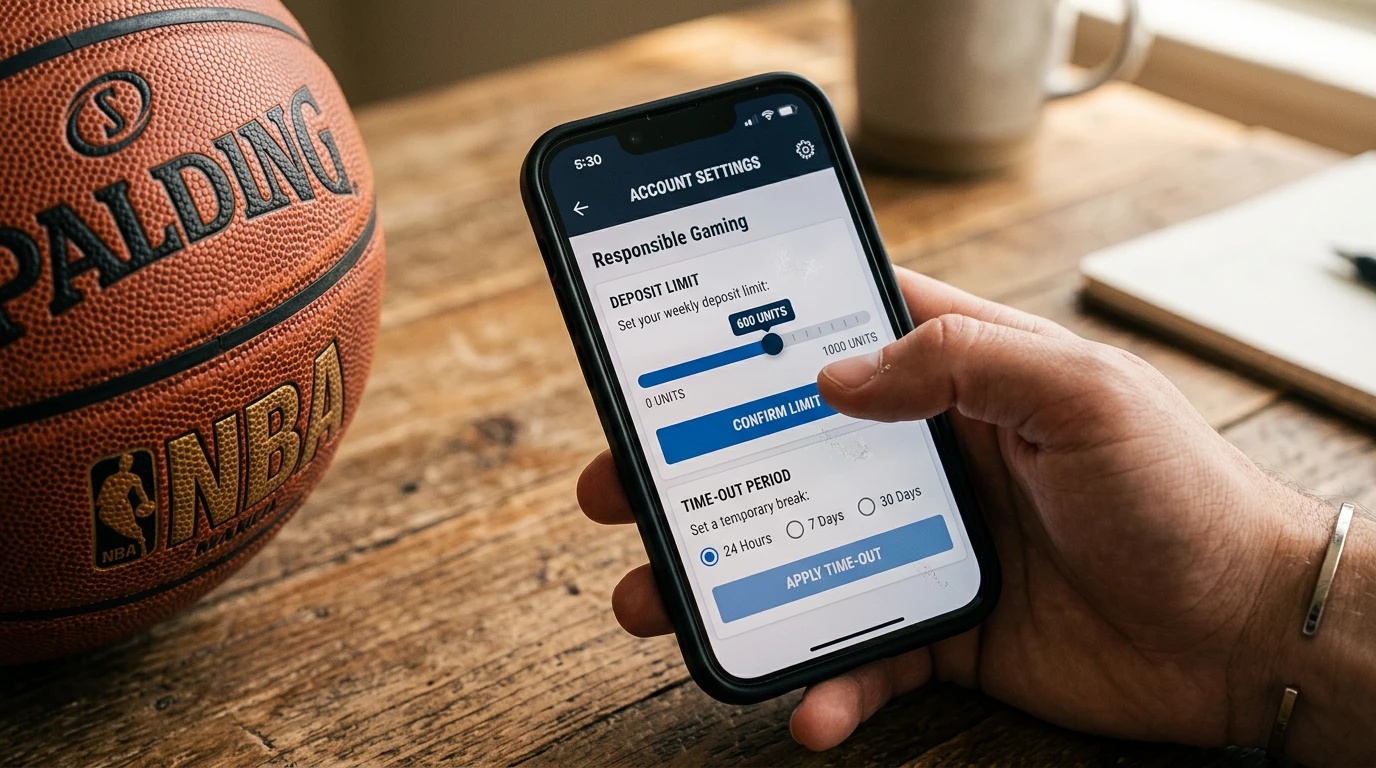
Table of Contents
NBA responsible gambling tools are the part of the betting infrastructure I tell every new punter to set up before they place a single wager. The standard advice is to focus on staking discipline and bankroll size – which is true, and I have written about both at length – but the most reliable enforcement mechanism for that discipline is not willpower. It is a deposit limit that you set when you are sober, considered and not chasing a Game 7 swing. The limit does the work for you in the moment when willpower is least available.
The framing matters here. Deposit limits and self-exclusion tools are not failure flags. As Grainne Hurst, Chief Executive of the Betting and Gaming Council, said in the most recent Safer Gambling Week statement: “These record-breaking figures underline the industry’s ongoing commitment to raising standards and ensuring the millions of people who enjoy a regular flutter do so in a safe and responsible environment.” Using the tools is the recreational punter’s normal mode of operation, not an admission of crisis. The harder numbers behind this – including a problem gambling rate of 2.7% across UK adults and a meaningful spike in the 18-to-24 age group with PGSI scores from 1 to 27 reaching 21.9% in the latest survey – explain why every UK-licensed operator now offers these tools by default rather than as a hidden buried setting.
The deposit limit mechanic is straightforward and consistent across every major UK-licensed operator. You set a daily, weekly or monthly cap on the amount of money you can move from your bank account into your betting account. Once you hit the cap, further deposits are blocked until the limit period resets. The wager itself is unaffected – if you have already moved money into the account, you can still bet – but new deposits are gated.
The detail that catches punters out is the directional asymmetry of changes. UK regulations require operators to apply increases to deposit limits with a cooling-off period – typically 24 hours – between the request and the new limit taking effect. The intent is to prevent in-the-moment decisions to raise limits during a losing session from translating into immediate further deposit access. Decreases to deposit limits, by contrast, take effect immediately. Lowering a limit happens instantly; raising it requires you to wait.
For UK NBA punters, the deposit limit period that tends to work best is weekly rather than daily. The NBA schedule is heavily clustered around weekend slates and late-week prime-time fixtures, and a daily limit can be too restrictive on a Friday or Saturday when three or four meaningful games are available. A weekly limit gives the flexibility to allocate stake across the week’s slate while still enforcing a hard cap that prevents the worst version of a chasing session.
The interaction with bankroll discipline is worth underlining. A deposit limit is not a substitute for stake-sizing rules – it is a backstop in case the stake-sizing rules break down. The two tools work in different layers: the staking plan governs the size of any individual bet, while the deposit limit governs the total exposure across a period. For more on how the two layers interact in practice, the discussion of how bankroll discipline pairs with deposit limits covers the structural relationship between in-bet discipline and account-level guardrails.
The time-out is the lighter cousin of self-exclusion. It is a temporary account suspension – typically available in fixed lengths of 24 hours, 7 days, 30 days, or 6 weeks – during which you cannot log in, deposit, or place bets. Open bets are typically settled normally during the time-out, and the account remains otherwise intact. Once the time-out expires, the account resumes operation at its previous settings.
I have suggested time-outs to plenty of punters over the years, and the resistance I usually meet is the assumption that a time-out is for someone with a problem. It is not. It is for someone who has noticed that they are reaching for the app slightly more often than they would like, or who has had a rough week and wants a structural break from the betting decision cycle. The 24-hour time-out is the lightest possible version, and it is the one I use myself on weeks when the NBA schedule has been chaotic and I have noticed my discipline slipping.
The cooling-off period is the regulatory cousin of the time-out – a structural delay between an action and its effect. Cooling-off periods are baked into the framework around limit increases, account reopening after self-exclusion, and several other administrative actions. They are not user-configurable; they are operator obligations. Their function is to put time between an impulsive decision and the consequence of acting on it, which is exactly the friction the regulatory framework was designed to introduce.
Single-bookmaker self-exclusion is the basic version – you tell one operator to close your account and bar you from reopening it for a defined period, typically with options ranging from six months to five years. The exclusion covers all products at that operator, and the operator is required to take active steps to prevent you from creating a new account under different details during the exclusion period.
GamStop is the multi-operator escalation. It is a national self-exclusion scheme, run by an independent non-profit, that every UKGC-licensed online operator is required to integrate with. Registering with GamStop excludes you from every UK-licensed online gambling operator simultaneously, for a period of six months, one year, or five years. The exclusion is enforced by the operators rather than by GamStop directly – when you register with GamStop, the operators receive the exclusion data and block account creation and existing accounts under those details.
The scope of GamStop is worth being clear about. It covers UKGC-licensed online operators only. It does not cover land-based betting – high street bookmakers and casino premises are governed by separate exclusion schemes – and it does not cover offshore unlicensed sites, which is one of the reasons the offshore market has been pulling UK punters during periods when GamStop registration has spiked. Punters who register with GamStop because they recognise a developing problem and then move to offshore sites are essentially undoing the protection they just put in place, and the structural answer to that gap is enforcement against the offshore market rather than a wider GamStop scheme.
For UK NBA punters specifically, the GamStop interaction is uncomplicated. NBA betting flows through UKGC-licensed operators in the same way that football or horse racing does, and a GamStop registration prevents access to all of them in the same uniform way. There is no separate basketball-specific scheme, and there does not need to be.
Reality checks are the lightest tier of the responsible gambling toolkit and the one most punters never adjust from defaults. A reality check is a pop-up message that interrupts a betting session after a defined period – typically every 30 or 60 minutes by default – and shows you a summary of session length, total wagered and net result for the session. The session does not pause unless you choose to close it; the reality check is purely informational.
The under-appreciated value of a reality check is in what it does to attention. A long session of in-play NBA betting can blur together – you place a bet, watch ten minutes of a game, place another bet, refresh the standings – and the cumulative time and stake can become invisible within the flow. The reality check pulls you out of the flow long enough to register what has actually happened, which is sometimes all that is needed to either close the session or recommit to it with clearer eyes.
Net deposit displays are the related feature on the account interface itself. UK-licensed operators are required to make net deposit information accessible – most show a rolling figure for the previous 28 days alongside the standard account balance – and the display is the basic feedback loop that lets a punter track their actual financial position rather than the headline balance. I treat net deposit as the most important number in my account interface, and I check it before placing a meaningful stake on any single NBA game.
NBA vs NFL betting is the comparison every UK us sports betting uk punter eventually has to make. Both leagues sit at the centre of US sports betting handle, both…
NBA prediction markets sit in an awkward space in the UK betting…
NBA playoffs betting is what hooked me on basketball markets in the…
A reader once sent me a screenshot of a five-leg NBA same-game…
