Line Shopping NBA Odds Across UK Bookmakers
If there's one habit that separates UK NBA punters who improve year-over-year from those who don't, it's line shopping. I learnt this the slow way - for my first three…

Speed up your KYC process at UK NBA betting apps. Compare fast-onboarding bookmakers, verify your ID quickly, and unlock your exclusive welcome bonus.
 Available in US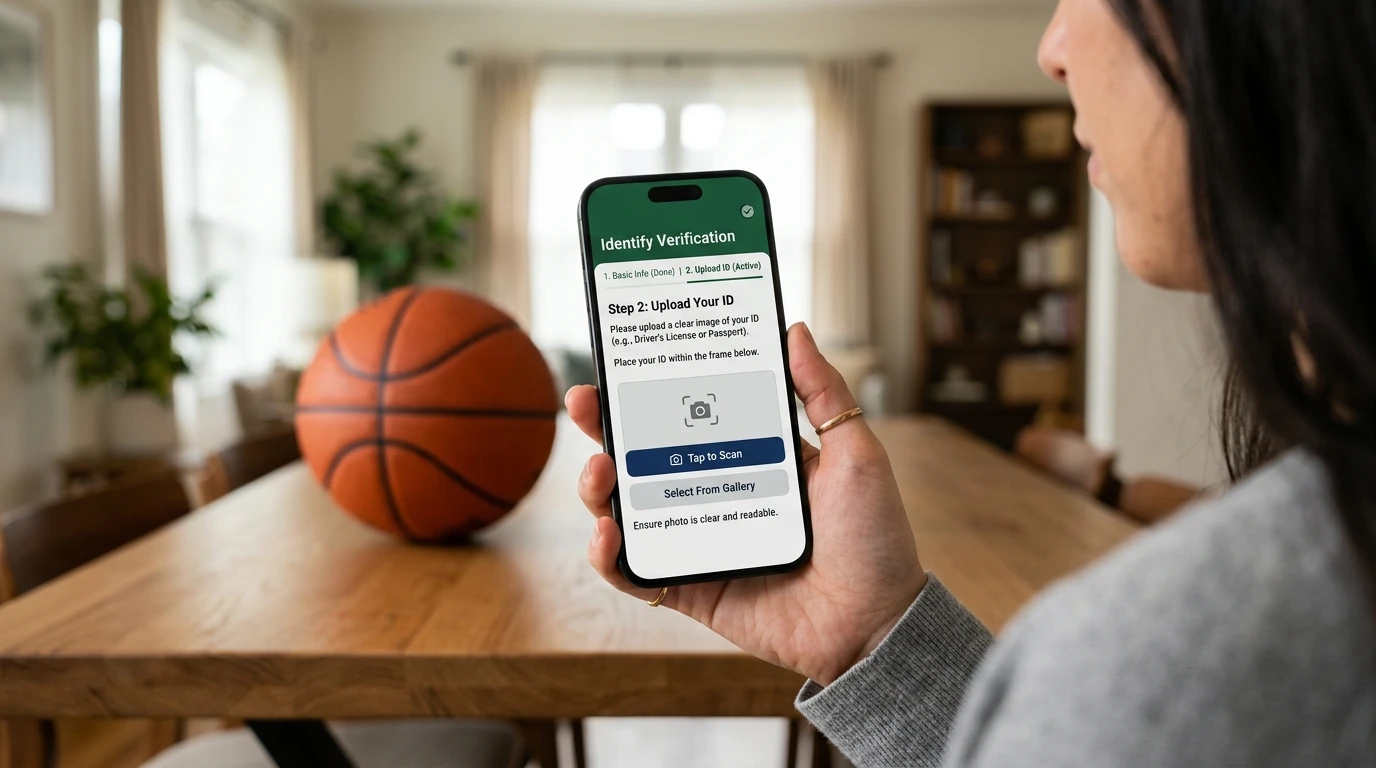
Table of Contents
NBA bookmaker KYC is the part of the betting account experience that turns the largest number of punters off the licensed market entirely. The friction is real – uploading a passport at midnight before an NBA game tip-off is not anyone’s idea of a good time – but the process behind it is one of the most important consumer protections in the UK gambling framework. Know Your Customer obligations exist to make sure the person opening a betting account is actually the person whose name is on it, and the mobile onboarding flow is the operational expression of that obligation.
The scale of this matters more than punters often realise. The UK now has roughly 13.5 million active monthly online betting accounts, up 2% year on year, and 78% of all online sports bets in 2024 were placed through mobile devices rather than desktops. Every one of those accounts went through some version of KYC onboarding, and the operators who do the process well retain customers at considerably higher rates than the ones who turn account creation into a multi-day ordeal. This guide walks through what the process involves, why specific documents are requested, and where most NBA-focused punters trip over the requirements without needing to.
The document set for identity verification uk bookmaker onboarding is consistent across the major operators. The headline requirement is proof of identity – typically a current passport or a current UK photo driving licence – and proof of address, usually a recent utility bill, council tax statement or bank statement showing your name and home address. The standards behind these requirements come from financial-sector anti-money-laundering rules adapted to the gambling sector, which is why the documents look familiar to anyone who has opened a bank account.
The detail that catches punters out is the recency requirement on the address proof. Most operators want a utility bill or statement dated within the previous three months, and a council tax statement dated within the previous twelve months. Older documents are typically rejected even if the address itself has not changed. The fix is straightforward – keep a recent statement saved as a PDF on your phone before you start the onboarding process, and you avoid the most common rejection reason in one piece of preparation.
Several operators now accept a wider range of identity documents – UK residence permits, biometric residence cards, and in some cases EEA national ID cards. The acceptance criteria vary by operator and are documented in the onboarding flow itself. If your primary photo ID is something other than a passport or driving licence, check the operator’s documentation list before starting onboarding to confirm it is accepted, because uploading an unsupported document and having it rejected is one of the most common reasons onboarding ends in customer service escalation.
A small number of operators have moved away from manual document uploads entirely, replacing the process with electronic identity verification that runs against credit reference agency records, the electoral register and other public data sources. This is the frictionless onboarding model, and where it works it is faster than a manual flow. Where it does not work – because the public data the operator has access to does not match your declared details closely enough – the system falls back to a manual upload anyway.
The standard NBA betting app onboarding sequence runs through five stages in roughly five to fifteen minutes. Stage one is the registration form – name, date of birth, address, email, phone number, and password. The form is the single most error-prone stage of the onboarding flow, because any later mismatch between what you typed here and what your documents say will surface later as a rejection or a request for further documentation. Type slowly and check the spelling of your name and address against your documents before submitting.
Stage two is the deposit setup – payment method linking, deposit limit defaults, marketing preference selection. The deposit method linking is where the operator’s payment processor performs its own checks against the card or account details. A card with a billing address that does not match the address on your registration is the most common failure point at this stage, and the fix is to ensure the card billing address matches what you entered on the registration form.
Stage three is identity verification. On a frictionless flow this stage runs in the background and completes before you reach the next screen. On a manual flow you upload the required documents – typically photographing them with your phone camera through the operator’s app – and the app validates the images for readability, completeness and a match against the registration data. If the validation succeeds, the app advances. If it does not, you are asked to retake or re-upload.
Stage four is biometric verification, which most major operators now use as a second factor for higher-risk onboarding flows. The flow asks you to record a short video of your face – typically following a simple prompt to turn your head or speak a code – and matches the live capture against the photo on your uploaded ID. This step has reduced fraud rates materially and is increasingly a default rather than an enhanced check.
Stage five is the responsible gambling preferences – deposit limits, time-out options, reality check intervals. The defaults vary by operator but most apps now prompt for active confirmation of these settings rather than letting them sit unset. The framework around responsible gambling tools and the broader account-level controls is where account onboarding meets the boundary with affordability checks explained in more detail – the two processes share data and triggers, but they sit in different parts of the regulatory architecture.
The single most common onboarding failure I see UK punters report is the name-mismatch rejection. The registration form is filled in casually – middle name skipped, or an Anglicised version of a first name used – and the documents uploaded later carry a different version of the same name. The system flags the mismatch and requests further verification, which delays the account by anywhere from a few hours to several days while customer service reviews the discrepancy.
The second common failure is the address proof rejection. The document is too old, the address on it does not exactly match the registration, the document is illegible because the photograph was taken at an angle, or the document is from a source the operator does not accept. The fix is preventive – choose your address proof before you start the onboarding flow, photograph it on a flat surface in good light, and check that every line of the address matches the registration character by character.
The third common failure is the deposit method rejection. The card you are trying to link is registered to a different name, or to an address that does not match. UK gambling regulations limit deposits to methods registered in your own name, which is why a card registered to a partner or family member will be rejected even if you have permission to use it. The fix is to use a card or account in your own name from the start, and to ensure the billing details match the registration.
The fourth – and this is more common than punters expect – is the biometric verification failure. The video capture fails because of poor lighting, glasses creating glare, hair partially covering the face, or simple software-side image quality issues. The fix is to retry in better lighting with the phone held steady and the face clearly visible. Operators allow multiple retries before escalating to manual review, so a failed first attempt is not the end of the process.
KYC and affordability checks are sometimes confused but they are operationally different processes governed by different parts of the regulatory framework. KYC is identity verification – it answers the question of whether the person opening the account is who they say they are. Affordability is risk assessment – it answers the question of whether the account holder’s activity sits within a financially sustainable pattern for their declared circumstances.
The two processes overlap at the point of onboarding, because some of the data sources used for KYC are also used for the initial affordability profile. A credit reference agency check that confirms your identity also surfaces signals about your financial position that the operator’s affordability model can incorporate. The check is the same touchpoint with the bureau; the use of the resulting data is different.
The temporal pattern is also different. KYC is essentially a one-off event at the start of the account relationship, with occasional refreshes when circumstances change. Affordability is continuous – the operator’s risk model runs against your activity in real time, and the data feeding it updates as your behaviour evolves. A clean KYC outcome does not protect you against an affordability flag triggered three years later by a change in staking patterns, and vice versa.
For UK NBA punters specifically, the practical implication is to treat KYC as a one-time housekeeping task and affordability as an ongoing process. Get the documents right the first time, keep them refreshed when circumstances change, and accept that the affordability model is going to be looking at your activity throughout the account’s life. That framing keeps both processes from feeling adversarial and turns them into structural features of how a UK-licensed market operates.
