Line Shopping NBA Odds: Finding the Highest UK Payouts
Maximize profits by line shopping NBA odds across UK bookmakers. Compare divergent prices, build a sportsbook portfolio, and claim multiple sign-up bonuses.
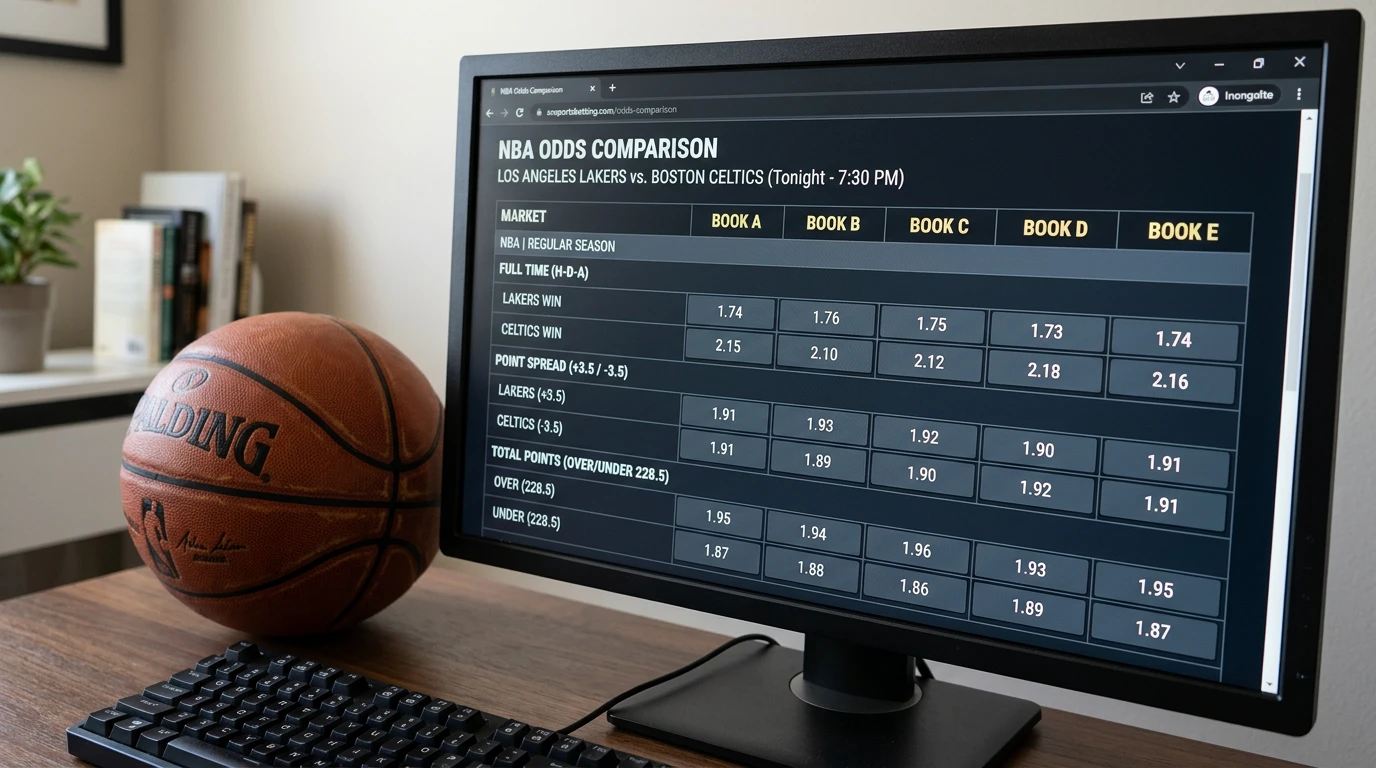
If there’s one habit that separates UK NBA punters who improve year-over-year from those who don’t, it’s line shopping. I learnt this the slow way – for my first three seasons, I bet exclusively at one operator because I liked the app. Then I started cross-checking prices on a notepad before placing each bet, and within two months I realised that the same NBA spread was routinely 5 to 10 cents cheaper at two other books on the same Saturday afternoon. That accumulated price gap turned out to be the largest single source of edge I could control. Not selection. Not modelling. Just shopping.
Line shopping is the practice of comparing the same NBA market across multiple UK bookmakers and placing your bet at the operator offering the most favourable price. The arithmetic is simple. The discipline is harder than it sounds, because the temptation to “just bet quickly before tip-off” pulls every punter back toward whichever app is already open.
NBA Odds Divergence: Finding Value Across Sportsbooks
UK bookmakers don’t all use the same pricing models. They share some inputs – power ratings, injury data, public-money signals – but each operator runs its own algorithm, makes its own venue and rest adjustments, and applies its own margin layer. The result is that the “same” NBA market has slightly different prices at different books on any given evening.
The structural cause of divergence is competitive positioning. Some UK operators chase volume and run tighter margins to attract sharps; others chase recreational customers and run wider margins to protect their margin on impulsive bets. Some books model NBA in-house; others license a feed from a third-party odds provider. The 13.5 million average monthly active online accounts in the UK in Q4 2024-25 – up 2% year-on-year – spread their volume unevenly across operators, with bigger operators tending to lead price movement and smaller operators trailing.
The other cause is information lag. Late-breaking injury news takes minutes to propagate across operators. A starter ruled out 90 minutes before tip-off will move the line at the fastest operator first, then at the second-fastest, and so on. UK punters who watch multiple books during the European afternoon can sometimes catch a price that hasn’t yet adjusted, particularly on midweek games where the operator’s risk team isn’t watching the NBA market in real time.
Price divergence is bigger on niche markets than on featured ones. Marquee Saturday-night games have prices that converge to within a cent or two across operators because every operator’s model is focused on them. A Tuesday-night Charlotte-versus-Sacramento fixture can have 5-cent gaps on the moneyline because the operators haven’t dedicated equal modelling attention.
Building a shortlist of operators
The first practical step is deciding which operators to keep accounts with. The honest answer is more than one, but how many depends on how seriously you plan to shop.
Three is the minimum I’d recommend for any UK NBA punter who wants to take line shopping seriously. With three accounts, you can compare the spread, the total, and the moneyline across three books in the five minutes before tip-off, and pick the best price on each. Adding a fourth or fifth account adds marginal value – the best price on any given market usually sits in your top two or three options – but adds operational overhead that most casual punters underestimate.
What to look for in operator selection: tight pricing on the markets you actually bet, consistent availability of cash-out on those markets, and a sensible deposit-and-withdrawal experience. Volume metrics across UK remote betting – Q4 2024-25 saw online betting GGY of £596 million, up 5% year-on-year – suggest UK operators compete most aggressively on featured fixtures and weekend slates. The operators that price tightest on Saturday-night NBA are often the ones running the largest in-house models.
The trap is concentrating all your shopping on one operator’s better featured-fixture pricing. If that operator is tight on Saturdays and wide on midweek games, and you bet across both, you’re getting the worst of both worlds at the single book. The shopping value comes from picking the best operator for each market on each evening, which requires the discipline of checking before every bet rather than picking a “primary” operator.
Mobile versus desktop pricing quirks
Here’s something most UK guides don’t mention – the same operator sometimes shows different prices on its mobile app and its desktop site for the same market at the same time. Not always. Not on every market. But often enough that it’s worth checking.
The cause is operational lag in the price update pipeline. Mobile apps refresh on different schedules than the desktop site, and during periods of fast line movement – particularly post-injury news – the two channels can briefly diverge. The gap usually resolves within minutes, but a punter sitting on the mobile app while a starter gets ruled out might see a price that’s already stale relative to the desktop value.
The gap can run either direction. Sometimes the mobile is faster, sometimes desktop. Across operators, there’s no consistent pattern – it depends on each operator’s tech stack. The practical answer is to check both channels when you suspect a fast-moving market and lock in the better price on whichever channel shows it first.
One specific quirk that UK punters should know: bet builders and SGPs sometimes have slightly different pricing on mobile versus desktop because the correlation engine sometimes runs in different versions on the two channels. I’ve seen 10-leg bet builders priced at 15/1 on the desktop and 14/1 on the mobile app at the same operator at the same moment. That’s a real gap, not measurement noise.
Tracking CLV after you’ve shopped
The point of line shopping isn’t to feel clever about catching a price 5 cents better than the alternative. The point is to bank the systematic edge that consistent shopping creates over time. The way to verify that you’re actually banking it is to track closing line value on the bets you placed after shopping.
If you took +150 at Operator A because it was 10 cents better than the +140 available at Operator B, and the closing line at Operator A drifted to +135, your CLV at Operator A is positive. If the closing line at Operator B was also +135, you can verify that your shopping captured an extra 10 cents that the broader market subsequently agreed wasn’t there. That’s a confirmation that shopping is paying off, not just that you’re winning lucky bets.
The interesting case is when shopping changes your CLV direction. Sometimes Operator A’s price at entry was generous because Operator A’s model was about to revise down, while the broader market never followed. In that case, your CLV at Operator A looks positive, but the bet itself was at a true probability that wasn’t beatable. Cross-operator CLV – measuring against the consensus closing price across the market, not just your operator’s closing price – is the strongest test.
UK punters who want to verify the long-term value of shopping should track a few hundred bets and compare two CLV measurements: against the operator they actually used, and against the operator they would have used if they hadn’t shopped. The difference between those two numbers is the shopping value. For a step-by-step walkthrough of how to interpret CLV results and what minimum sample size makes the signal meaningful, the use CLV to confirm whether shopping is paying off piece works through the maths.
How many UK bookmakers should you keep accounts with for NBA betting?
Three is the practical minimum for genuine line shopping; four or five if you bet heavily across midweek games where price divergence is wider. Beyond five, the operational overhead of checking each account before every bet outweighs the marginal price improvement. Focus on operators with tight pricing on the markets you actually bet rather than the operators with the loudest welcome offers – the welcome bonus is a one-time benefit, but the per-bet price gap compounds across every wager you place.
Do aggregator prices match what is actually bookable?
Not always. Aggregators typically pull prices on a periodic refresh schedule rather than in real time, so a price displayed by an aggregator may be 30 seconds to 2 minutes stale. The price you see when you click through to the operator"s site is the bookable price. Aggregators are useful for spotting which operator currently leads on a given market, but verify the price at the operator before placing the bet, particularly on fast-moving markets in the final 30 minutes before tip-off.