NBA Acca Edge and Acca Insurance
NBA acca insurance and acca edge promotions are the part of the UK bookmaker product offering that look most generous on the homepage and most fiddly in the small print.…

Compare NBA prediction markets and betting exchanges with UK bookmakers. Find superior peer-to-peer pricing and claim exclusive sign-up offers today.
 Available in US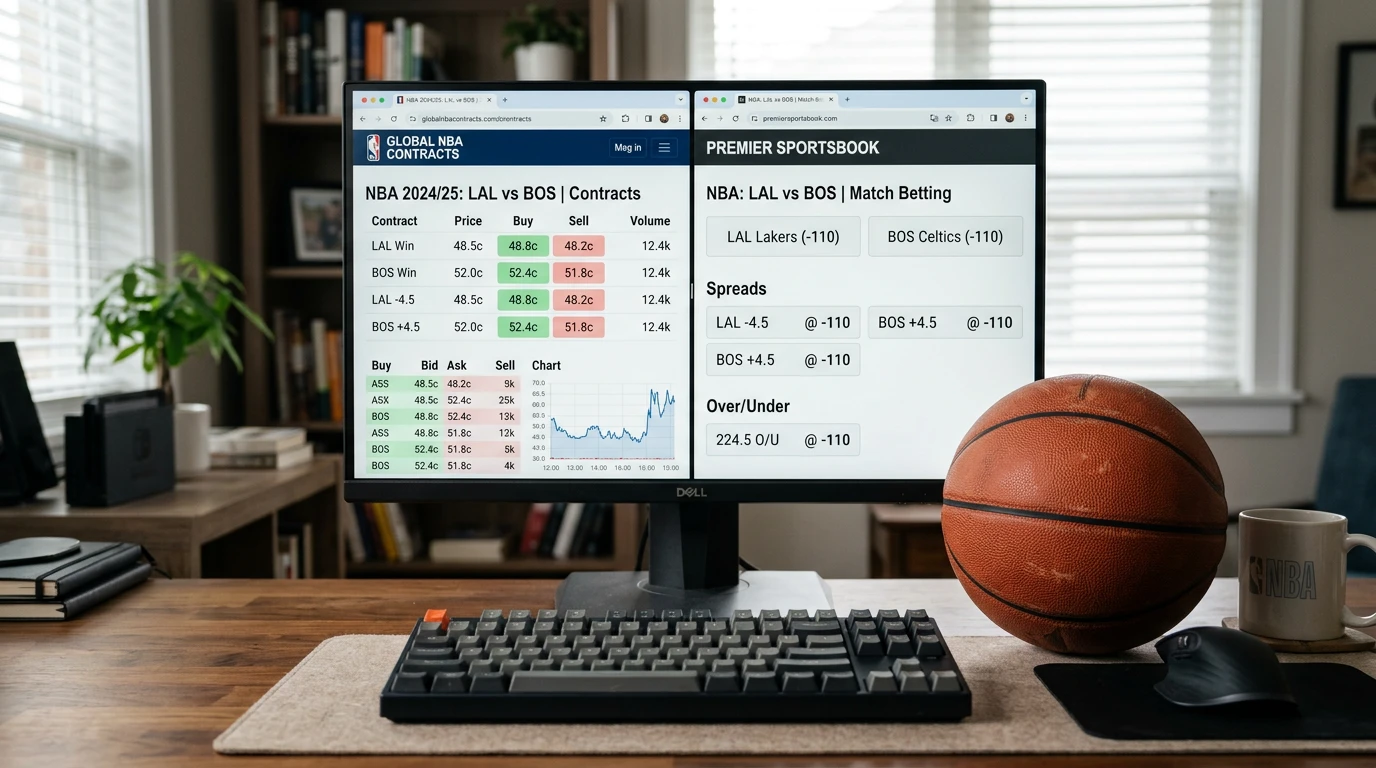
Table of Contents
NBA prediction markets sit in an awkward space in the UK betting landscape – visible, increasingly well-funded, and yet operating outside the framework that governs every UK-licensed traditional bookmaker. The peer-to-peer pricing model the prediction-market platforms use is structurally different from the bookmaker model UK punters are used to, and the two products produce closing prices that often look similar but arrive there through entirely different mechanisms. Understanding the difference matters because the regulatory treatment, the consumer protection profile, and the practical betting experience are all different.
The context is important. The NBA itself has been notably ambivalent about how the broader US sports betting market evolved over the past seven years. As Adam Silver put it in a Sports Illustrated interview last November: “When sports betting was legalized, the NBA wasn’t at the table. These were deals cut between states and gaming operators.” That observation applies with even more force to the prediction-market segment, which has expanded into US sports markets through a regulatory route that bypasses the state-by-state gaming framework entirely. For UK punters considering whether to engage with prediction-market contracts on NBA outcomes, the regulatory question is the first one to answer, before any consideration of pricing or product fit.
The prediction-market mechanism is fundamentally an exchange model. Instead of a bookmaker setting a price that customers either take or leave, a prediction-market platform runs an order book where participants post bids and offers, and the market price emerges from where those bids and offers cross. A polymarket nba contract on a championship outcome trades the same way an exchange-traded fund trades – the price moves as buy and sell pressure interacts, and the platform takes a small fee on each transaction rather than building margin into the line itself.
The pricing implications of this model are mostly positive for the user. Without a bookmaker’s margin to overcome, the implied probabilities on prediction-market contracts often look better than the comparable price at a traditional sportsbook. A team priced at +150 on a moneyline at a UK book might trade at a contract price that implies a slightly shorter price on the equivalent prediction market, with the difference roughly equal to the bookmaker’s margin minus the prediction-market platform fee.
The kalshi nba product structure pushes this further by listing event contracts on specific binary outcomes – will a named team win the championship, will a specific player exceed a defined statistical threshold, will a series go to seven games. The contracts settle to either zero or one dollar based on the resolution, and they trade continuously at prices between those two endpoints. The pricing discipline that comes from a market-driven order book is generally tighter than a bookmaker’s posted line, and the closing prices on liquid prediction-market contracts have historically been some of the most efficient signals available in the US sports market.
The limitation is liquidity. Prediction-market platforms only price the contracts where order-book activity supports continuous trading, which means the menu of available NBA markets is narrower than a UK sportsbook menu. Headline outcomes – championship winner, conference winner, series winner on major matchups – have deep order books. Player props, specific quarter totals, and most novelty markets either do not exist on the prediction-market platforms or trade in volumes too thin to produce reliable pricing.
The exchange model has a UK-licensed equivalent in the form of betting exchanges that have operated in the UK market for years. The mechanics of nba exchange betting on a UK-licensed exchange – placing a back bet that someone else lays, or laying a bet that someone else backs – sit closer to the prediction-market model than to a traditional bookmaker. The key UK-specific point is that betting exchanges hold full UKGC licences and operate within the same consumer protection framework as traditional bookmakers, which puts them in a different regulatory category from the offshore prediction-market platforms.
The pricing differences between UK betting exchanges and traditional UK bookmakers parallel the prediction-market story. Exchange prices tend to be tighter on the headline markets because the user-against-user model removes the bookmaker’s margin, replacing it with a smaller commission charged to winning bets. Traditional bookmakers offer broader prop menus, faster settlement and a more familiar interface, but they price with margins that compound over a betting career in ways that meaningfully affect long-run results.
The lay-bet concept is the key conceptual departure from traditional sportsbook thinking. A back bet is a wager that something will happen – the standard sportsbook wager. A lay bet is a wager that something will not happen – taking the other side of someone else’s back bet. The maths is straightforward but the working through the implications takes practice. Laying an NBA team to win at 3.0 decimal odds means you collect a stake unit if they lose any way at all, and pay out two stake units if they win. The risk profile is the inverse of a back bet, and the strategic uses are different from anything a traditional bookmaker offering can replicate.
For sharp UK punters, the betting exchange option offers genuine advantages on certain markets – the closing line on heavily-traded outcomes is tighter, the lay-bet structure allows hedging strategies that a sportsbook does not facilitate, and the price-discovery process is more transparent than a posted bookmaker line. The offset is that the exchange model concentrates liquidity on the most popular markets and produces thin pricing on the long tail of options that a traditional book carries comfortably.
The regulatory question is where the prediction-market story gets complicated for UK residents. Prediction-market platforms operating under US Commodity Futures Trading Commission oversight are not licensed by the UK Gambling Commission, do not appear on the UKGC public register, and do not offer the consumer protections that UK-licensed gambling operators are obligated to provide. The platforms themselves typically restrict access by geography, and UK residents who attempt to access them often find that account creation, deposits or withdrawals are not supported from UK addresses.
The UK Gambling Commission has been clear in public communications that financial products designed to function as gambling – including event contracts that settle on sports outcomes – fall within the UKGC’s regulatory perimeter when offered to UK consumers, regardless of how the operator characterises the product in its home jurisdiction. The practical effect is that a UK resident attempting to use a US-regulated prediction-market platform to trade NBA outcomes is engaging with an operator that does not have a UK licence, even if the operator holds a different kind of regulatory authorisation elsewhere.
The legality test from a UK consumer perspective is essentially the same one that applies to the offshore bookmaker landscape – the platform either holds a UKGC licence or it does not, and the absence of a licence places the activity outside UK consumer protection regardless of any other regulatory cover the platform claims elsewhere. The underlying logic is identical to the legality test that black-market sites fail, even though the prediction-market platforms operate in a more sophisticated regulatory environment than typical offshore sportsbooks.
The UK sports betting market is itself projected to grow to $21.3 billion by 2030, with a compound annual growth rate of 11.4%, which means the UK-licensed alternative to offshore or non-UK-regulated prediction markets is itself a deep and competitive ecosystem. Channelisation has slipped from 97% in 2019 to 92% in 2025, and the UKGC has signalled continued enforcement focus on operators that solicit UK custom without a UK licence regardless of the regulatory framing they use.
The risks of engaging with prediction markets from a UK address compound in ways that punters who are used to the UK-licensed framework do not always anticipate. The first is the obvious one – money deposited on a platform that does not accept UK customers is at risk of being frozen, refused for withdrawal, or held indefinitely if the platform’s geo-blocking mechanisms identify the account as a non-eligible jurisdiction. The platforms have legitimate compliance reasons to enforce these restrictions, and the enforcement is often retroactive on accounts that were created before geo-blocking caught up with them.
The second risk is settlement disputes. Prediction-market contracts settle against defined events, but the definition of the event sometimes leaves room for interpretation in edge cases – a postponed game, a team withdrawing from a tournament, an outcome that depends on factors not anticipated in the contract specification. UK consumer protection does not apply to disputes over contract settlement on platforms outside the UKGC framework, and the dispute resolution path is the platform’s own internal process plus any rights the user has under the platform’s home jurisdiction.
The third risk is tax treatment. Winnings from UK-licensed gambling are not taxed in the hands of the punter. Income from contracts traded on a US-regulated prediction-market platform sits in a different tax category and may produce different obligations depending on the user’s specific circumstances. UK residents who use prediction-market platforms should account for the tax implications rather than assuming the UK gambling treatment applies by default.
The fourth and most underrated risk is the lack of integrity assurance. UK-licensed operators participate in integrity monitoring networks that share suspicious-activity data with leagues and regulators. Prediction-market platforms operate within their own integrity frameworks, which may or may not align with the integrity controls UK punters expect on NBA markets. Following the 2025 Rozier-Billups indictments, the integrity question on NBA outcomes is more pointed than it was 18 months ago, and the answer depends on which framework the platform you are using actually sits within.
NBA acca insurance and acca edge promotions are the part of the UK bookmaker product offering that look most generous on the homepage and most fiddly in the small print.…
The first time I cashed a UK NBA point spread ticket, the…
The NBA London game betting cycle in 2026 sat at a strange…
NBA responsible gambling tools are the part of the betting infrastructure I…
