Line Shopping NBA Odds Across UK Bookmakers
If there's one habit that separates UK NBA punters who improve year-over-year from those who don't, it's line shopping. I learnt this the slow way - for my first three…

Master NBA point spread betting with top UK bookies. Compare handicap lines, exploit half-point margins, and secure lucrative sign-up bonuses for 2026.
 Available in US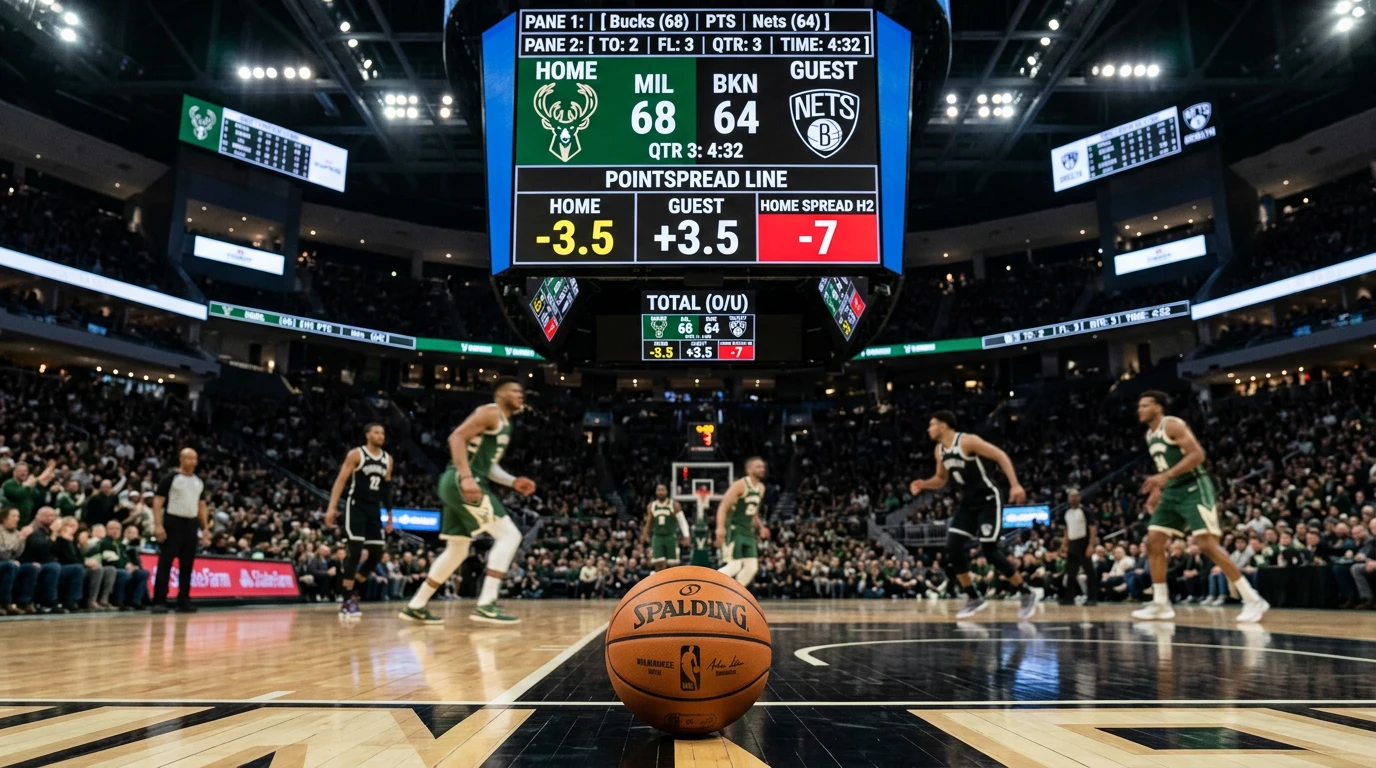
Table of Contents
The first time I cashed a UK NBA point spread ticket, the favourite lost the game by two and I still won the bet. That single contradiction – backing a team that loses on the scoreboard and walking away with your stake plus profit – is what hooks most British punters on the NBA spread. It’s the market that flips your football instincts inside out, because in the NBA you’re not asking who wins; you’re asking by how much. Or rather, you’re asking whether the bookmaker has set the right margin.
On UK sites the point spread is sometimes labelled “Handicap” or “Match Handicap”, which is closer to the language you’d see on a Premier League page. The mechanic is identical to American spread betting. A favourite is given a negative number – say -7.5 – meaning they need to win by eight or more for the bet to land. The underdog gets the equivalent positive number and either has to win outright or lose by seven or fewer. Both sides are typically priced near 10/11 in fractional terms, which is -110 in American or decimal 1.91. That symmetry is the point: the bookmaker has tried to draw a line that splits the action 50-50 and earns its margin through the vig.
Here’s something I learnt the hard way over a long January of bad bets – the opening spread you see on a UK book at midnight is not somebody’s emotional guess. It’s a number assembled from a power rating, a venue adjustment, a rest-and-travel modifier, an injury fade, and a starting overround. Behind every -4.5 sits a small factory.
The core ingredient is the power rating gap. Each team carries a season-long efficiency number – points scored per 100 possessions minus points conceded per 100 – and the difference between the two sides forms the base spread on a neutral floor. From there the book applies a home-court bump, usually around 2 points in the current era, down from 3 points a decade ago. Travel patterns, back-to-back fatigue, and the absence of a starter each peel away or add fractional points.
What surprises British punters who are used to thin football overrounds is how aggressive NBA hold can be. Across US sportsbooks the average hold percentage has climbed from roughly 6.7% in 2018 to over 9% in the 2024-2025 cycle, with point spreads at the lower end of that range and player props at the higher end. UK operators tend to price NBA spreads tighter than the US average because they’re competing within a market where online betting GGY across the full remote sector grew 8% year-on-year to £1.42 billion in Q2 2025. Volume pressure squeezes the vig down.
The hold matters because it tells you where the value lives. A spread priced at -110/-110 has roughly 4.5% combined overround. Move that to -105/-105 and the overround drops to about 2.4%. Same game, same teams, but the second book is asking you to climb a much lower wall before you’re profitable. That’s the whole argument for shopping prices on the spread.
In NFL betting, the discussion around key numbers is sacred. Three, seven, ten, fourteen. In NBA betting, that conversation barely happens – and that’s an opportunity for UK bettors who pay attention.
Why? Because NBA scoring is continuous. Two-point baskets, three-point shots, free throws – there’s no possession structure that pins margins to specific clusters the way American football’s touchdown-and-field-goal rhythm does. Look at a season-long distribution of NBA winning margins and you’ll see relative smoothness with mild peaks at certain integers. The most common winning margins cluster between 5 and 10, with a noticeable secondary cluster at 12 to 15. A spread of -7 or -9 sits inside the densest part of the curve, which is why those numbers are where pushes and near-misses sting most.
The practical takeaway is that buying half a point – paying a worse price to move -7 to -6.5 – earns you less than you’d think compared to NFL spreads. NBA margins drift; they don’t park on whole numbers as reliably as a field-goal-driven game would. So if a bookmaker is charging you a meaningful price increase to shift the line by half a point, you’re usually overpaying.
The exception is when starters are scratched late and the line moves through whole-number territory. If -5 drops to -3.5 after a star is ruled out, the underlying win probability has shifted enough that the half-point buy is no longer the relevant question – the new line is. UK punters chasing line moves on the morning of a game are usually trying to catch a price that hasn’t fully adjusted, not buying half a point on a stable number.
Picture this – I’m watching a Heat game on Prime Video, my ticket reads Heat -4, and they win by exactly four. That’s a push. Stake returned, nothing won, nothing lost. Slightly anticlimactic, but at least you got your money back.
The hook – that half-point on the end of -4.5 or +7.5 – exists specifically to eliminate pushes and force a binary outcome. UK bookmakers default to whole-number spreads on lower-profile fixtures because pushes are computationally cheaper to handle, but on televised marquee games you’ll almost always see half-point lines. The hook is a feature, not a friend. You pay for the certainty in slightly worse implied probability.
How a push settles depends on the operator, but the standard across UKGC-licensed books is straightforward: void the bet, refund the stake to the bet account. If the push is one leg of an accumulator or bet builder, that leg drops out and the remaining selections recalculate. Where it gets fiddly is on partial cash-out tickets that include a push leg – the maths is operator-specific, and I’d recommend reading the bet slip terms before clicking through a complex multi.
The half-point cost varies a lot. Going from -4 at -110 to -3.5 at -120 is a roughly 4-cent move in implied probability terms – a steep tax that’s only worth paying if you genuinely believe the four-point cluster is in play for that specific fixture. On most NBA games, it isn’t. You’re better off taking the whole number, accepting the small push risk, and saving the cents for the next bet.
The in-play NBA spread is one of the most reactive markets in any sport. A 10-0 run inside three minutes will shift a pre-game -6 to -2 and then back to -4 within a single timeout. The line breathes.
What drives live movement is straightforward in principle: each scoring possession changes the remaining game’s projected margin, and the algorithm rebalances. What’s interesting is how the line reacts to context that isn’t reflected in the scoreboard. Foul trouble on a star, a coach burning all his timeouts before halftime, a hot shooter sat down after three quick fouls – none of these change the score but all of them move the live spread. Reading those signals is the in-play equivalent of seeing the price before the public catches up.
There’s a useful piece of perspective from a different corner of the betting industry. After a Cheltenham Festival where most fancied horses lost, Betway’s communications head Chad Yeomans observed: “Obviously, for bookmakers, it was a Cheltenham to remember. It’s very rare that so many well fancied shots get beaten, so there was definitely no moaning from our side.” The point translates directly to NBA spreads. Bookmakers profit when public favourites fail to cover. A short-priced team that limps to a 1-point win is a profitable night for the book, because every recreational punter who took -5 on the chalk is paying the vig back. Live movement is the visible breathing of that supply-and-demand balance.
The trap with chasing live spreads is reaction speed. Streaming latency on UK platforms can run 20 to 40 seconds behind the actual play, while the bookmaker’s data feed is closer to real-time. That asymmetry means you’re often pressing bets on plays the book already knows about. If you want to read what’s behind every spread tick – including the margin the operator is holding back – there’s a the vig built into every NBA point spread breakdown that goes into the maths in detail.
If there's one habit that separates UK NBA punters who improve year-over-year from those who don't, it's line shopping. I learnt this the slow way - for my first three…
NBA line movement is the single most underrated information source for the…
The single best decision I made as a UK NBA bettor was…
NBA prediction markets sit in an awkward space in the UK betting…
