NBA vs EuroLeague Betting
NBA vs EuroLeague betting is a comparison that surprises punters who assume basketball is basketball. The two competitions look superficially similar, both produce televised content the UK market consumes regularly,…

Track NBA line movements to secure the best UK odds. Compare opening and closing prices, follow sharp money signals, and grab massive betting bonuses.
 Available in US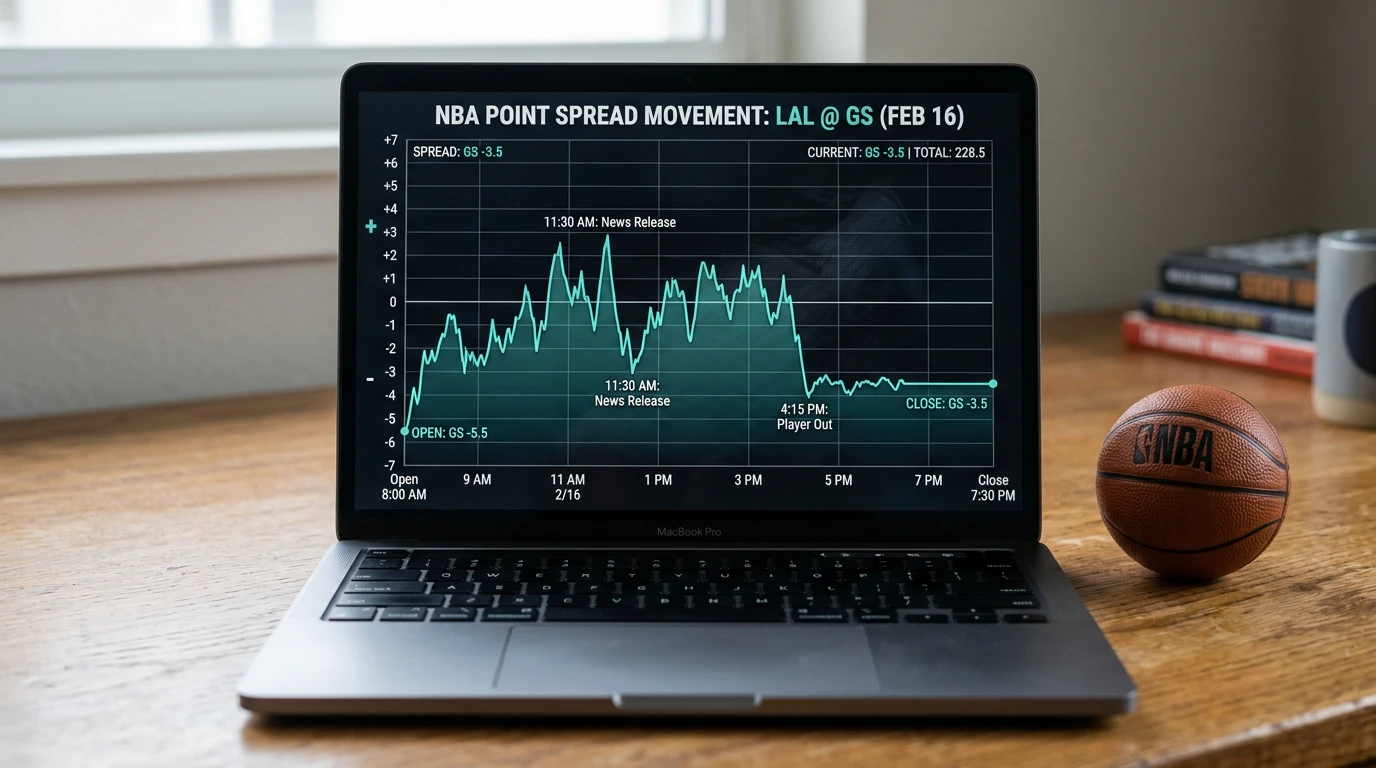
Table of Contents
NBA line movement is the single most underrated information source for the average UK punter. I have spent nine years watching numbers slide across my screens between the opening post and tip-off, and what I have learned is that the line tells a story long before any pundit gets around to writing it. A team’s spread does not drift from -4.5 to -6 by accident, and an under on the total does not steam from 225.5 to 222.5 because of vibes. Money moved it, and that money usually knew something.
The catch is that reading the move correctly is harder than spotting it. Plenty of punters see a number shift and assume sharp action when it is just a respected operator copying its competitor. Plenty more bet into a stale price because they did not check whether the consensus had already moved past it. Online betting in Great Britain generated a quarterly GGY of £1.42bn in Q2 2025, up 8% year on year, and a meaningful slice of that turnover sits on US sport – which means UK markets now move with American sharps almost in real time. The job is to tell signal from noise, and the rest of this guide walks through how I do it.
I once watched a Lakers spread open at -3 on a Tuesday morning and close at -6 by tip-off. No injury news, no rotation update, no obvious story – just steady, one-directional buying that the books absorbed without complaint. The Lakers won by eleven. That single afternoon taught me more about NBA market signal than any podcast I had listened to that month.
The opening line is the bookmaker’s best guess at a number that will split the action evenly. It is built from a mix of power ratings, recent form, rest, injury reports filed the night before, and travel. By the time the closing line is locked in, every meaningful piece of information has been priced in by professional bettors who pound any soft number the moment it appears. That is why the closing line is the most efficient market available to a UK punter, and why beating it consistently is the cleanest evidence that your process has an edge.
When the opener is -4 and the close is -6, the market is telling you the favourite was underpriced. Two points on an NBA spread is not nothing. A -4 bet against a -6 closer means you have grabbed positive expected value, regardless of whether that specific game lands. The opposite move – buying -6 when the close is -4 – is where most casual money lives, and it is exactly the position you do not want to take. Worth noting too: the bookmaker’s margin is baked into both numbers, which is why vig must be considered when reading line moves rather than treating the spread in isolation. A two-point move on a market priced at -110/-110 means something different from the same move on a -115/-105 board.
Five o’clock UK time on game day is when my screens go properly busy. That is roughly when American beat writers start filing pre-game shootaround reports, and an “out” or “questionable” tag on a starter can move a spread two full points before the average punter has finished their coffee. I have seen totals collapse by four points in the time it took me to refresh a page.
NBA injury news is the cleanest catalyst there is. When a top scorer is ruled out, the team’s spread typically softens by anywhere from two to five points depending on the player’s value and the depth behind him. When a defensive anchor sits, the total usually rises. The market processes these adjustments within minutes on the biggest books and within an hour on the slower ones, which is exactly the window where a quick UK punter can find a stale price on a smaller operator.
The harder reads come from softer news. A coach hinting at a minutes restriction on a returning player. A national broadcast pairing that changes refereeing patterns. A late-season tank where the public has not yet caught up to what the front office is signalling. These moves are slower and less consensus-driven, which makes them more interesting and more dangerous in equal measure.
The wider context matters here too. With 13.5 million active online accounts in the UK and rising operator competition, the speed at which mainstream books align has tightened considerably. But not every site you might stumble across is part of that ecosystem. As Grainne Hurst, Chief Executive of the Betting and Gaming Council, put it in a statement on H2 Gambling Capital research: “What we are seeing is a harmful black market scaling up at pace. Illegal operators are becoming more sophisticated, more visible and more aggressive in how they reach UK customers.” Stale lines on offshore sites are not an opportunity – they are a warning sign that the operator is not connected to the real flow of information.
Here is the question I get asked most often: what does it mean when the public is hammering one side, yet the line moves the other way? That is reverse line movement, and it is one of the most reliable steam-move signals in the NBA market.
The mechanic is straightforward. Books move lines to balance liability, but they also move them to respect respected money. When 75% of the tickets are on the Celtics -5 and the line drifts to -4.5, that move is being driven by a smaller number of larger bets on the opposite side – bets the book takes seriously enough to adjust against the grain of public action. The public is on one team. Sharps are on the other. The line follows the sharps.
I do not blindly tail every reverse move, because some of them turn out to be a single large recreational wager dressed up as wise guy money. But when I see a reverse line movement that coincides with a steam move across multiple books within ten or fifteen minutes – meaning the same number shifts on five or six independent boards almost simultaneously – that is the cleanest market signal I know how to read.
The trap is timing. By the time a reverse move is visible to a UK punter checking the market casually, the value may already be gone. The best price on the sharp side often disappears within the first wave of movement. If you cannot bet quickly, do not bet at all on a steam signal – you will end up holding the worst of the closing number rather than the best of it.
You do not need a Bloomberg terminal for this. My working setup is three tabs and a notebook, and it covers more ground than most retail bettors ever bother to chart.
Tab one is a UK consensus board – two or three of the larger licensed operators side by side so I can see when their spreads diverge by half a point or more. Divergence between two big books is usually short-lived and often signals a stale number. Tab two is a US-market reference, because American closing lines remain the gold standard for NBA efficiency and UK books frequently mirror them with a small lag. Tab three is news: official injury reports, beat-writer feeds, and the team’s own pre-game communications.
The notebook matters more than the tabs. I log the opener, any meaningful intermediate prints, and the close for every game I bet. After a couple of months you start to see your own patterns – which sides you tend to grab before the move, which ones you reach for after the steam has run, and which markets you should probably leave alone entirely. Most punters never measure their closing line value, which is why most punters cannot tell you whether they are beating the market or chasing it.
One UK-specific note: kick-off times for NBA games sit between one and four in the morning local time, so the heaviest line movement usually happens in the evening UK time, between dinner and bed. That is awkward for anyone with a day job, but it is also when the market is most active and most exploitable. Set price alerts where your bookmaker supports them, and resist the urge to bet first thing in the morning before the lines have moved – the prices you see at 8am UK time are the result of overnight US action, not an opportunity waiting for you.
NBA vs EuroLeague betting is a comparison that surprises punters who assume basketball is basketball. The two competitions look superficially similar, both produce televised content the UK market consumes regularly,…
If there's one habit that separates UK NBA punters who improve year-over-year…
The first time I tried full Kelly on NBA bets, I went…
The first NBA bet builder I tried genuinely thrilled me. Three legs,…
