NBA Cash Out and Early Payout
The first time I cashed out an NBA bet I felt clever for an hour, then watched the bet I'd cashed go on to win and felt foolish for two…

Discover how to watch the NBA in the UK. Compare Prime Video coverage with free bookmaker live streams, and claim exclusive in-play betting bonuses.
 Available in US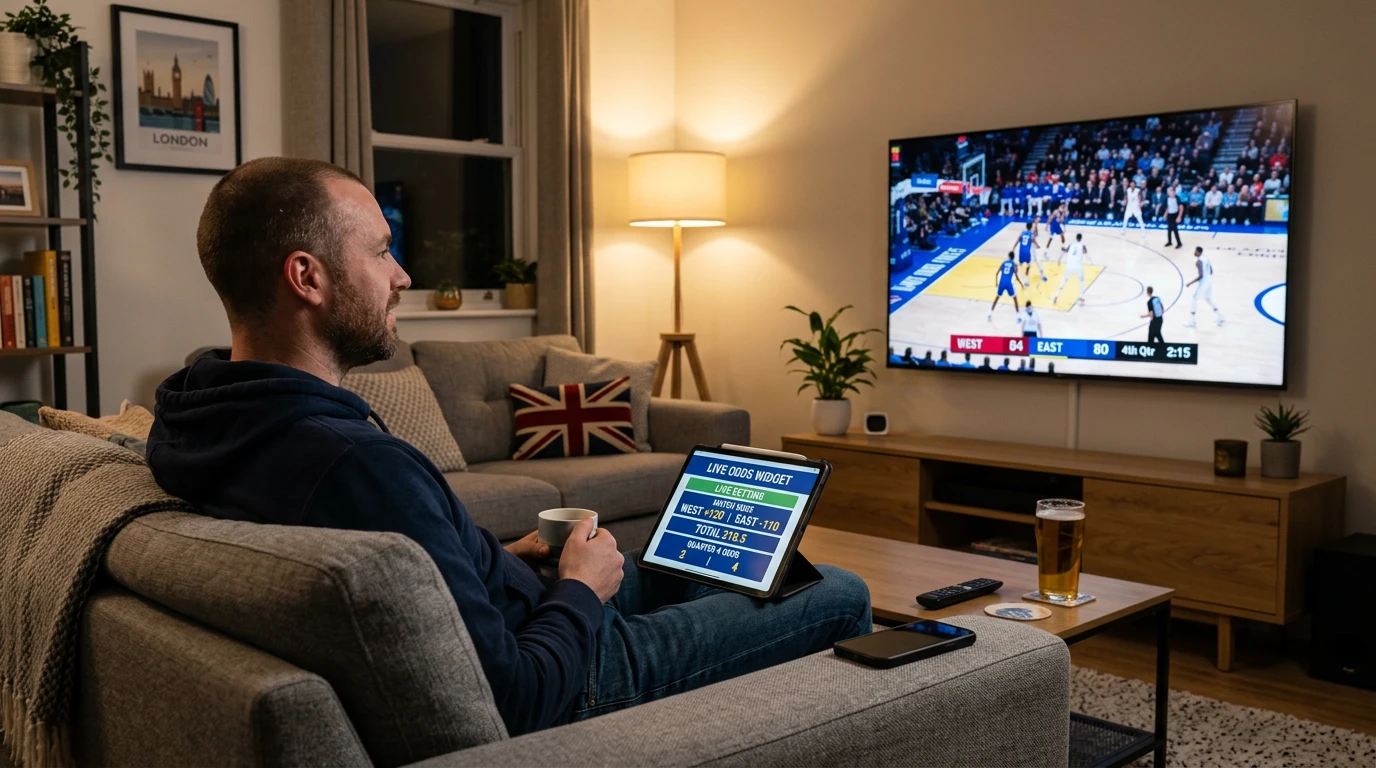
Table of Contents
Knowing how to watch NBA UK coverage properly is the unglamorous half of being a serious basketball bettor. I have lost count of the punters who place a same-game parlay at midnight, then watch it unravel in the morning highlights because they had no live coverage of the swing minutes. If you are putting real money on the league, you need a viewing setup that matches your betting setup – not the other way around.
The UK broadcast picture changed in October 2025 when an 11-year deal brought NBA games to Prime Video as part of the league’s new domestic rights structure. The viewership numbers that followed were not subtle. Prime Video NBA coverage in the UK saw a +444% year-on-year jump in audience figures across the 2025-26 opening months, which tells you both how starved the market was for accessible coverage and how quickly UK fans switched once the option appeared. For punters, that shift matters because live viewing changes how you bet – in-play markets reward watchers, not refreshers.
The October 2025 deal sits inside a longer global agreement that reshaped how the NBA distributes its content. For UK viewers, the practical version is straightforward: a substantial slate of regular-season games, plus playoff coverage, lands on Prime Video as part of a standard subscription, with NBA-branded studio output built around it. There are no separate basketball passes inside Prime Video itself, which is unusual for a US sport reaching a UK audience, and it removed one of the friction points that historically kept the league a niche product on these shores.
The catch is that Prime Video does not carry every game. The NBA plays roughly 1,230 regular-season fixtures, and even the biggest broadcast partner globally carries only a fraction of that schedule. The Prime selection skews towards marquee fixtures, nationally televised matchups in the US, and games that line up with UK weekend evening windows. Mid-week games between non-marquee teams often miss the Prime schedule entirely, which leaves a coverage gap that bookmaker streams and League Pass try to fill.
One viewing detail that matters for bettors: Prime’s UK presentation runs on the global feed for most games, which means commentary, graphics and stat overlays you would not get on a generic stream. The on-screen point differential and pace data are particularly useful when you are tracking live totals – I keep one eye on the pace number and the other on the spread, and the combination tells me more about an in-play bet than any tip sheet ever has. If you have already explored the London Game viewing context and betting recap, you will recognise how a flagship broadcast shifts both attention and turnover for a single fixture.
Most major UK-licensed bookmakers carry NBA live streams as part of their in-play offering, and for the games that fall outside the Prime schedule, those streams are often the only legitimate live option a UK punter has. The mechanics are familiar to anyone who has watched horse racing on a bookmaker site: you need a funded account, you usually need to have placed a qualifying stake in the last twenty-four hours, and the stream itself runs inside the betting interface.
Eligibility rules vary slightly between operators, but the patterns are consistent. Some require a minimum stake on the specific game you want to watch. Others ask for any stake of any size in the previous day. A handful run the stream open to all funded accounts with no qualifying bet, which is the friendliest version for casual viewers. None of the major UK books charge a separate fee for the stream itself – the cost is bundled into your existing relationship with the operator.
Quality is the trade-off. Bookmaker streams sit at a lower resolution than Prime Video, the commentary is often a basic international feed, and the latency runs anywhere from twenty to sixty seconds behind the live court – which matters enormously for in-play bets. I have watched an in-play under settle on the screen, opened a fresh tab to see the score, and realised a three-pointer had already changed the outcome thirty seconds earlier. Treat any in-play bet placed off a bookmaker stream with appropriate caution.
NBA League Pass remains the most complete viewing option for UK fans who want everything – every game, every angle, full archives, and the ability to choose home or away team commentary on supported broadcasts. It is also the most expensive of the legitimate options, with annual subscription prices set in pounds and structured around either a full-league pass or a single-team variant for fans who really only care about one franchise.
League Pass has historically been the home of the dedicated UK NBA viewer, and the audience figures from the league’s 2025-26 season suggest that audience is still growing rather than shrinking despite the new Prime arrangement. Globally, live NBA broadcasts drew 1.3 billion viewing hours through the season, up 93% year on year, and the UK contribution to that figure is no longer a rounding error.
Beyond Prime and League Pass, there are a few legitimate odds and ends – selected free-to-air highlights packages, NBA’s own social-media output for short-form clips, and the league’s app for condensed game replays. None of these are substitutes for live coverage if you are betting, but they are useful for context, scouting and post-game review. Avoid the obvious trap of unlicensed streaming sites: even leaving aside the legal question, the latency and reliability problems make them unusable for any serious in-play betting purpose.
The schedule is where most UK NBA viewers struggle, because the league plays in five US time zones and tips off at times that translate awkwardly to the UK clock. A typical Eastern Conference game starting at 7.30pm local Eastern time lands at 12.30am UK in winter, when the UK is on GMT and the US East Coast is on EST. A West Coast tip at 7.30pm Pacific is 3.30am UK time – a non-starter for live viewing unless you have a flexible morning.
The good news is that the bulk of nationally televised US games push back into the late evening US local time, which means weekend doubleheaders sometimes land in the 10pm-to-midnight UK window. That is the sweet spot for UK viewers, and unsurprisingly it is where Prime Video concentrates its scheduling. Christmas Day, the All-Star weekend, the playoff late-rounds and the Finals all carry significant UK-friendly programming, and the Finals in particular reach a peak of UK viewership when games fall on Friday or Sunday US evenings.
Daylight savings adds a wrinkle. The US and UK do not change clocks on the same dates in spring and autumn, so for roughly two weeks each year the gap shifts by an hour – a game that has been kicking off at 1am UK suddenly tips at midnight, or vice versa. Always check the official tip-off time in your local timezone the day before, rather than assuming the schedule you memorised last month still applies.
The first time I cashed out an NBA bet I felt clever for an hour, then watched the bet I'd cashed go on to win and felt foolish for two…
NBA vs EuroLeague betting is a comparison that surprises punters who assume…
If you'd asked me five years ago what I tracked to know…
Affordability checks NBA betting accounts trigger are the part of the UK…
