Flat Staking vs Unit Sizing for NBA Bankrolls
The single best decision I made as a UK NBA bettor was deciding, in writing, what one "unit" meant before I placed my first bet of any given season. The…

Avoid illegal NBA black-market sites in the UK. Compare fully regulated UKGC bookmakers, guarantee fast payouts, and claim safe sign-up bonuses today.
 Available in US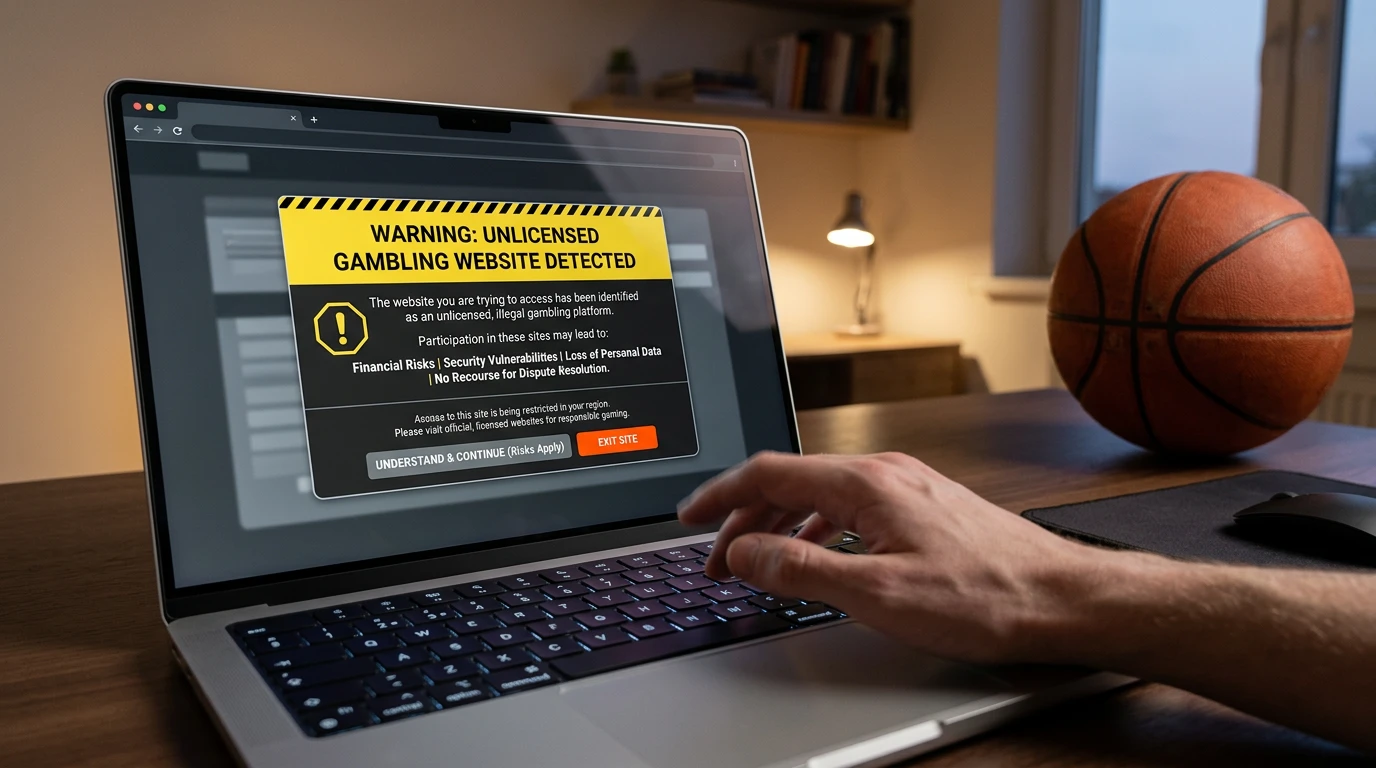
Table of Contents
NBA black market betting uk risks are not a theoretical worry. The unlicensed market in this country has tripled in size over the past six years, and a meaningful fraction of that growth has come from offshore sites that target UK NBA fans with English-language interfaces, sterling deposit options, and aggressive bonus offers that look better than anything a UKGC-licensed operator could legally run. Some of the sites are operated by experienced offshore licence holders with reasonable internal controls. Others are essentially scam infrastructure designed to take deposits and refuse withdrawals. Telling the two apart from a UK punter’s screen is harder than most people think.
I do not have an ideological problem with offshore gambling – punters in many countries legally use offshore books because their domestic regulated market does not provide the products they want. The problem in the UK is different. Punters here have access to a deep, competitive licensed market with proper consumer protection, and the offshore sites targeting UK customers offer almost nothing the licensed market does not – except the absence of affordability checks and the absence of recourse when something goes wrong. The trade is bad for the punter, and most punters who make it do not understand what they are actually trading away.
The numbers tell the scale of the problem. Research published by H2 Gambling Capital in 2025 sized the UK black market for gambling at around £16.6bn – roughly three times the figure estimated for 2019. That growth has come against a backdrop of expanding domestic regulation, tighter advertising rules, and a UKGC enforcement effort that has been more active than at any point in the past decade. The unlicensed sites have grown in spite of, not because of, a regulatory gap.
The channelisation rate – the percentage of UK gambling activity that flows through licensed operators – tells the same story from a different angle. Channelisation has slipped from 97% in 2019 to 92% in 2025, meaning the unlicensed share of the UK gambling market has roughly tripled in proportional terms over six years. Some of that slippage is the natural consequence of an expanded regulatory perimeter – activities that did not count as gambling in 2019 are now caught by UKGC oversight, which mechanically lowers channelisation when they sit outside it – but a large fraction is genuine substitution of unlicensed for licensed play.
The sports betting share of that black market is harder to pin down precisely, but the NBA-specific subset has grown faster than the average because the offshore market has positioned itself as the home of US sports betting for European users. Many of the largest offshore brands run dedicated NBA promotional campaigns, sponsor English-language basketball content, and operate marketing partnerships designed specifically to reach UK punters during the NBA season. The economic incentive is straightforward – UK punters are valuable customers, and the offshore market knows it.
The unlicensed nba bookmaker playbook for reaching UK customers follows a consistent pattern. Step one is a domain that looks like a UK property. The use of .com endings rather than .co.uk does not automatically signal an unlicensed site – plenty of legitimate UK-licensed operators use .com domains – but offshore sites overwhelmingly favour generic top-level domains, and the visual presentation is carefully crafted to look indistinguishable from a UK consumer experience.
Step two is the bonus offer. Unlicensed sites offer headline bonuses that the licensed market cannot legally match – extreme matched-deposit percentages, unrealistic free-bet packages, loyalty schemes with no documented wagering requirements. The economics of those bonuses only make sense if the operator never expects to honour a significant fraction of the resulting payouts, which is precisely the point. The bonus is the lure; the unpaid withdrawal is the catch.
Step three is the payment infrastructure. Offshore sites push punters towards payment methods that are harder to chargeback or recall. Cryptocurrency is the most obvious version of this, but it is not the only one. Some offshore operators route deposits through third-party processors in jurisdictions where the consumer’s home-country protections do not apply. Some require unusual identification documents that are hard to produce, then use the documentation issue as a reason to delay or deny withdrawals indefinitely.
Step four is the marketing – affiliate networks, paid social media, sometimes television advertising in jurisdictions where the operator can legally place adverts that reach UK viewers. The marketing is sophisticated and well-funded, and a UK punter who lands on an unlicensed site via an aggressive affiliate redirect may have no obvious indication that anything is wrong.
The risks of using an offshore nba bookmaker uk start with the withdrawal problem. The most common pattern is straightforward – deposits are processed quickly, small withdrawals are honoured to maintain plausibility, and the first significant withdrawal triggers a sequence of verification requests, document re-submissions, and delays that drag on for weeks or months. The operator is not technically refusing the withdrawal; it is simply making it impossible to complete. The end state is that the punter writes off the balance.
The second risk is settlement disputes. UK-licensed operators are required to participate in Alternative Dispute Resolution schemes, which means a punter who disputes a settlement has an actual independent body to appeal to. An offshore operator has no equivalent obligation, and its terms and conditions typically specify that disputes are resolved through internal review or through the laws of an offshore jurisdiction where the punter has no realistic legal recourse.
The third risk is account closure. An offshore operator can close an account at any time for any reason and is not obligated to release the balance. UK-licensed operators face strict regulatory obligations around account closure and balance handling, and a closure dispute can be escalated through UKGC enforcement channels. The equivalent escalation against an offshore operator is essentially impossible.
The fourth risk, increasingly important as integrity concerns have grown across the basketball market, is the absence of any meaningful integrity controls. Licensed UK operators participate in integrity monitoring networks, share suspicious-activity data with the league and the regulator, and apply prop-bet restrictions in line with the integrity decisions the NBA and its commercial partners have made. Offshore sites typically do none of these things. A UK punter on an unlicensed NBA market may find that the prop they are betting is structured against them by other customers who have access to information the licensed market would not permit.
The first practical check is the verification routine – every site should be verified against the UKGC public register before any deposit is made. The step-by-step verification on the UKGC public register takes less than two minutes and is the single highest-leverage piece of due diligence available to a UK punter.
The second check is the marketing source. If you arrived at the site through an affiliate link, a social media advertisement, or a search result that did not flag the site as a sponsored result for a UKGC-licensed operator, treat the site with extreme caution. Aggressive affiliate marketing is one of the most reliable indicators of an offshore operator, and the UK-licensed market is constrained by advertising rules that limit the kinds of promotional approaches an unlicensed operator can deploy freely.
The third check is the payment mix. A site that supports the major UK debit card networks, established e-wallets recognised in the UK, and direct bank transfer through the UK banking system is almost certainly UK-licensed. A site that pushes you towards cryptocurrency, obscure payment processors, or methods that route your money through a third-party jurisdiction is almost certainly not.
The fourth check is the customer service mechanism. UK-licensed operators provide UK contact details, documented complaints procedures, and an explicit reference to the Alternative Dispute Resolution scheme they are registered with. The absence of any of those elements is a serious warning sign, and the absence of all of them is a clear indicator that the site sits outside the UK consumer protection framework.
The single best decision I made as a UK NBA bettor was deciding, in writing, what one "unit" meant before I placed my first bet of any given season. The…
The first time I cashed a UK NBA point spread ticket, the…
The first NBA bet I ever placed in the UK was a…
I've been burying small futures positions in NBA championship markets for nearly…
