NBA Totals Betting
For my first NBA season as a working analyst, I obsessed over moneylines and ignored totals. Big mistake. Once I started tracking results, the totals book was where my most…

Construct high-paying NBA same game parlays at UK bookmakers. Compare pricing for correlated legs, apply top templates, and claim exclusive SGP bonuses.
 Available in US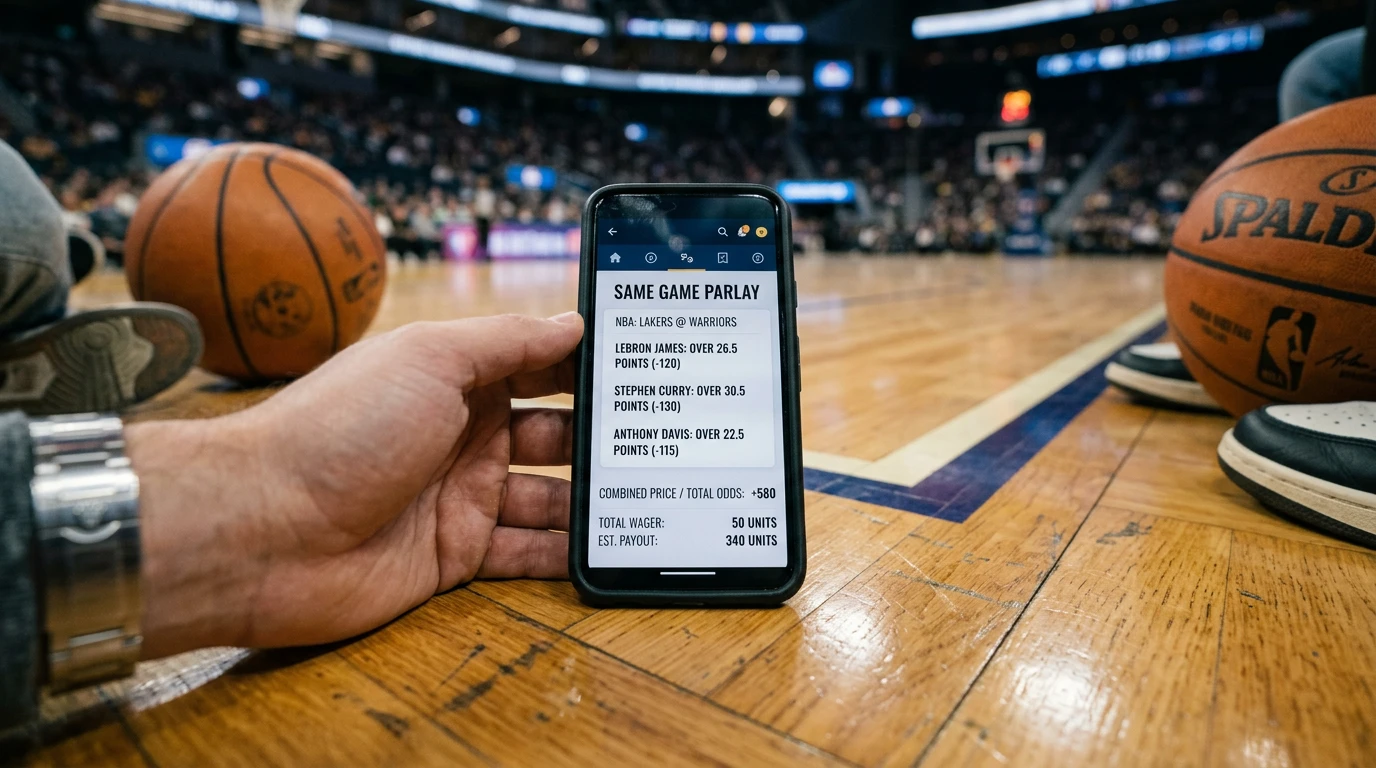
Table of Contents
A reader once sent me a screenshot of a five-leg NBA same-game parlay priced at 15/1 and asked whether it was a good bet. My honest answer was that I had no idea, because nobody outside the bookmaker’s pricing engine could tell from the screenshot alone. That’s the awkward truth about same-game parlays – they’re seductive because the multiplied odds look juicy, but the price is a black box that bakes in correlations between legs in ways most punters never see. After nine years of building and busting these tickets, I think every UK punter should know how the pricing actually works before they click confirm.
A same-game parlay, called a “same game multi” by some UK operators, combines two or more selections from a single NBA fixture into one bet. The legs might be a spread, a total, several player props, and a team prop, all from the same game. The whole thing settles as a single wager – every leg must win for the ticket to cash. The selling point is the multiplier. The hidden cost is the correlation maths the bookmaker is doing on your behalf.
Here’s where I’d push back on the way most UK guides explain this – they treat a same-game parlay as if it’s a normal accumulator with different scenery. It isn’t. A normal accumulator multiplies the decimal odds of independent legs and that’s roughly it. A same-game parlay can’t do that because the legs aren’t independent.
If you pick the over 224.5 on a Hawks-Pacers game, and you also pick Trae Young over 27.5 points, those two selections are positively correlated. If the total goes high, the chance that Trae has scored heavily goes up. The bookmaker can’t price these legs independently because that would over-pay you on a correlation that already exists. So the SGP engine reprices the second leg, conditional on the first leg winning, and the multiplier you see is less than the straight multiplication of the two decimal prices.
What that means in practice is that a five-leg SGP at 15/1 might have multiplied to 40/1 if the same selections were placed independently across different games. The lost odds are not the bookmaker robbing you – they’re the correlation adjustment. Whether that adjustment is fair depends on how aggressive the operator’s model is. UK bookmakers generally price SGPs a touch tighter than US books, because online betting accounts for 78.47% of UK sports betting revenue and operators compete hard on price for high-volume products.
The combined hold on an SGP can sit anywhere from 8% to 20%, with average US sportsbook hold percentages rising from roughly 6.7% in 2018 to over 9% in 2024-2025 even on simpler markets. UK SGP hold typically runs lower than US equivalents on featured games but can run higher on niche markets where the model relies more on assumption. The longer the parlay, the higher the cumulative margin.
The classic example of a correlated NBA pair is moneyline plus alternate spread. If the Knicks win the game, the chance they covered -3.5 isn’t 50% anymore – it’s well above 50%, because winning is a precondition of covering. So an SGP combining “Knicks moneyline” with “Knicks -3.5” is heavily correlated, and the bookmaker will price it more tightly than the standalone parlay maths would suggest.
The trickier examples are partial correlations. Jayson Tatum over 27.5 points and Boston over 118.5 team points – those are correlated, but not perfectly, because Tatum could score 35 in a 110-point team game or 22 in a 125-point game. The bookmaker’s model has to estimate the joint probability based on play-by-play data from thousands of games. You’re not seeing that model; you’re seeing the price.
Where punters lose money is by stacking correlated unders on the same player. Tatum under 27.5 points, Tatum under 4.5 assists, Tatum under 1.5 three-pointers – these are heavily correlated. If Tatum has a bad shooting night, all three legs tend to cash together. The bookmaker prices the package as if they’re highly correlated, which strips most of the multiplier out of the parlay. So you’re effectively paying for one event – a poor Tatum game – at parlay-style risk for non-parlay-style reward.
Independent legs are scarce inside a single NBA game. Pretty much everything happening on the floor depends on tempo, score state, foul trouble, and rotation choices, all of which spill across players and totals. A small handful of selections are genuinely close to independent – a niche prop on a player who’s been benched and a starter-driven game total, for example – but even those carry some residual correlation through factors like garbage time.
If I had to list the SGP shapes I see most often on UK bookmaker landing pages and in punters’ screenshots, four templates would cover almost everything.
First, the “star plus team” stack. A star player’s points over plus their team’s moneyline. Highly correlated, generally priced reasonably by the bookmaker, and a sensible bet if you genuinely believe the team wins through that star’s scoring. The price reflects the correlation so you’re not getting paid as much as the standalone multiplication suggests – but you also have a fighting chance of cashing.
Second, the “over-the-top” stack. Game total over, both teams’ team totals over, and a star player’s points over. This is essentially four ways of betting on one outcome – a high-scoring game – and the bookmaker prices it accordingly. The multiplier looks attractive in isolation but, once you back out the correlation discount, you’re not getting much more than a clean game-total over with one leg.
Third, the “underdog hits big” stack. Underdog moneyline plus a star player on the underdog hitting a points-rebounds-assists alternate line. Genuinely positively correlated and offers real value when you have conviction on the upset, because the standalone moneyline alone often underpays the upset narrative.
Fourth, the “anti-correlation trap”. Team A moneyline plus Team B’s star scoring over their points line. If Team B is being blown out, their star plays fewer minutes and the over goes down. So you’re combining bets that work against each other, and the SGP price drops below where it should be. UK operators are usually wise to this and will reject combinations that swing too negatively correlated.
The biggest psychological trap is the multiplier. 15/1 looks like a long shot in a good way. 15/1 on a five-leg SGP where the underlying true probability is closer to 20/1 is actually a worse bet than 10/3 on a moneyline. The headline number disguises the work the bookmaker is doing under the hood.
The second trap is leg substitution. UK SGP builders allow you to swap legs and watch the multiplier change in real time, which feels like price discovery. It isn’t. The price changes because the correlation matrix recalculates, not because you’ve found a better deal. If you’re building an SGP by hunting for the highest multiplier at each step, you’re optimising for headline odds rather than for expected value. That path usually leads to highly correlated stacks that cost a lot of cumulative margin.
The third trap is the void-leg rule. If one leg of your SGP is voided – a player ruled out before tip-off, a market suspended – the remaining legs typically recalculate. The new multiplier is almost always lower than what you originally booked. Some UK operators offer “best-of” rules that protect against this, but most don’t. Read the bet slip.
The fourth trap is comparing to bet builders. They’re related products but not identical. Bet builders typically allow broader market selections and use a slightly different correlation engine, with the lower bound on price often set by operator-specific exclusions. The how bet builders differ from same game parlays piece walks through where the two product types diverge in practice and which one tends to give better implied probability on a given combination.
For my first NBA season as a working analyst, I obsessed over moneylines and ignored totals. Big mistake. Once I started tracking results, the totals book was where my most…
The first NBA bet I ever placed in the UK was a…
A two-way contract NBA betting scenario looks innocuous on a UK punter's…
If there's one habit that separates UK NBA punters who improve year-over-year…
