UK NBA Cash Out Strategies: Securing Early Profit Settlements
Lock in profits instantly with NBA cash out and early payout offers. Compare UK bookmakers with the best settlement triggers and claim your welcome bonus.
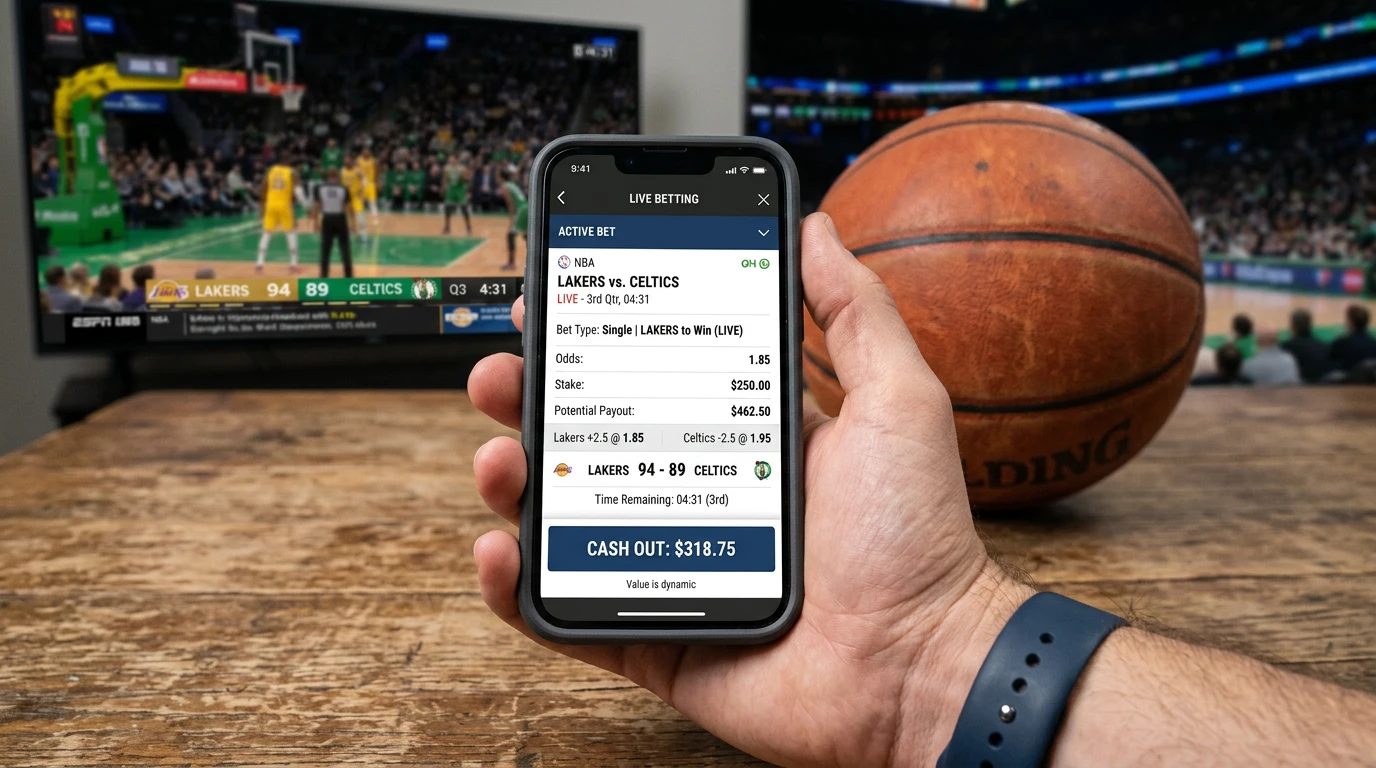
The first time I cashed out an NBA bet I felt clever for an hour, then watched the bet I’d cashed go on to win and felt foolish for two weeks. Cash out is the most psychologically charged feature in UK NBA betting. It promises control and dangles a number that almost always feels like a fair deal in the moment. Whether it actually is depends on maths the bookmaker is doing in the background – and the maths is not your friend in the way the button design implies.
Cash out lets you settle a bet before the event ends, accepting a value calculated by the bookmaker’s model in exchange for closing out your position. Early payout is a related but distinct promotion: certain qualifying bets get paid out as winners if a specific in-game threshold is reached, even if the eventual result goes against you. Both features have proliferated across UK NBA betting in lockstep with the wider growth of the online market – online GGY across the full UK remote betting sector grew 8% year-on-year to £1.42 billion in Q2 2025 – and operators have invested heavily in cash-out engines to differentiate their products. The context matters. Grainne Hurst of the Betting and Gaming Council called the November 2025 budget tax increase “a devastating hammer blow to tens of thousands of people working in the industry across the UK, and millions of customers who enjoy a bet”, and operators are now hunting for margin in features like cash-out where the implicit pricing is hardest for customers to verify.
Cash-Out Values: How UK Bookmakers Calculate Early Payouts
Picture the moment – you’ve backed the Heat at +150 on the moneyline, the game is in the fourth quarter, Miami is up by six, and your bet slip suddenly shows a cash-out offer of £18.50 on a £10 stake. How did the operator arrive at that number?
The mechanics are not complicated. The bookmaker calculates the current live probability that Miami wins from the current game state. Say it’s 78%. The “fair” price for the remaining bet, ignoring margin, would be 1 ÷ 0.78 = decimal 1.28. Your original ticket pays £25 in total return (£15 profit on a £10 stake at +150). The bookmaker’s fair value on your position is £25 × 0.78 = £19.50. The cash-out offer is £18.50, which is £19.50 minus £1.00 of bookmaker margin. That margin is the cash-out hold – usually 4% to 8% of the fair value, depending on operator and market.
Some operators offer cash-out values closer to fair; others apply a wider margin. There’s no published standard, and the only way to gauge whether your operator’s cash-out is reasonable is to compute the implied fair value yourself and compare. UK punters who place high volume on a single book sometimes get noticeably better cash-out values than new accounts, which suggests at least some operators tier the offer by customer profile.
What the cash-out value doesn’t include is your own conviction. If you took the original bet because you thought the price was wrong, and the game has played in line with your read, then your edge is still intact and accepting the cash-out value is locking in someone else’s number. The button design encourages you to think of cash-out as risk-free profit. It’s actually trading your live edge for the bookmaker’s adjusted edge.
Partial versus full cash out
Full cash out closes the position entirely. Partial cash out – available on most UK bookmakers – lets you take back a portion of the stake at the current implied value, leaving the rest of the bet active. So you might cash out £6 of a £10 bet, taking £8.50 of guaranteed money, with £4 still running on the original odds.
The partial mechanic is genuinely useful when you’ve doubled up after a major in-game swing and want to protect a profit floor while leaving upside intact. The classic case is when your bet has gone from +150 at placement to -300 live – say, your underdog is now leading by ten in the third quarter. Pulling out the original stake plus a small profit, while keeping a fractional position on the original price, lets you ride out a potential collapse without exiting the bet entirely.
The catch is that the partial cash-out value carries the same margin as full cash-out, so you’re paying the bookmaker’s hold on the portion you withdraw. Doing serial partial cash-outs through a long game – taking 30% out at half-time, another 30% out in the third quarter, the rest at the start of the fourth – racks up margin three times. By the time you’ve fully exited via a sequence of partials, you’ve paid materially more than you would have on a single full cash-out at the same moment.
Early payout triggers and how they reshape value
Early payout is the feature that genuinely changes expected value rather than just shifting it. The classic UK early-payout trigger on NBA betting is “team to be ahead by X points at any stage of the game – bet paid as winner”. Most operators offer some version of this, often as a promotion attached to weekend featured fixtures.
The most common trigger across UK books is a 15-point or 20-point lead. If your moneyline pick goes 15 ahead at any stage in regulation, the bet pays as a winner regardless of the eventual result. This is a legitimate value-add because NBA leads collapse more often than fans expect – somewhere around 25% of teams that lead by 20 in the fourth quarter end up losing – and the early-payout rule pays you on the lead rather than the outcome.
The catch, naturally, is in the qualifying criteria. Early payout often requires you to opt in to the promotion before placing the bet, applies only on a specific list of fixtures, caps the maximum payout at a defined ceiling, and frequently excludes accumulators or bet builders with more than a stated number of legs. Read the terms carefully. A featured fixture’s early-payout rule on a moneyline at +200 capped at £100 maximum payout is a £200 effective maximum on a £100 stake, regardless of how high the original odds were. If the early-payout trigger fires and your full odds would have paid £300, you collect £200 plus stake, not the full price.
Across the 78.47% of UK sports betting revenue that comes through online channels, early payout is a marketing differentiator more than a long-term EV product. Operators run it because it improves customer retention. Whether it adds value to your specific betting depends on the matchup, the trigger, and the cap.
When cash-out disappears
Cash-out vanishes more often during an NBA game than punters expect. The reasons fall into three categories: market suspensions, integrity flags, and ticket-specific exclusions.
Market suspensions happen during basket-and-foul situations, contested possessions where the bookmaker’s price feed can’t keep up with the play, and brief moments after a star player is injured before the algorithm reprices. During suspension, the cash-out button greys out, and any pending request you’ve already placed sits in a queue until the market reopens. Some operators void the cash-out request on suspension and require you to re-submit at the new offer.
Integrity flags suspend cash-out on specific markets when the bookmaker’s risk team flags unusual activity. Player prop cash-outs disappeared on several markets during the October 2025 Rozier-Billups indictment news cycle. The market doesn’t reopen until the operator’s compliance team clears the flag.
Ticket-specific exclusions vary by operator. Promotional bets – free bets, deposit-bonus stakes, certain boost-attached tickets – often have cash-out disabled by design. Tickets placed via certain payment methods may also be excluded. The bet slip should state whether cash-out is available, but sometimes the indicator is only visible inside the active-bet view rather than at placement.
For the in-play context that shapes when cash-out is most or least likely to be available, the how cash out interacts with live markets piece works through the live trading dynamics in more detail.
Is the cash out value always lower than the original stake-to-win?
Not always. If your bet is winning in-play, the cash-out value can exceed the original stake but will always be less than the maximum potential return on a winning original ticket. If your bet is losing, the cash-out value is lower than your stake and may approach zero on heavily losing positions. The cash-out always carries the bookmaker"s hold, typically 4% to 8% of the fair value, so even an evenly-poised bet will return a cash-out figure slightly below mathematically fair value.
Why does cash out disappear when the market is suspended?
The cash-out value depends on a live price feed for the underlying market. When the market suspends – during basket-and-foul situations, after major in-game news, during integrity flags – the operator cannot generate a reliable cash-out figure and the button greys out. Cash-out reopens when the market resumes, usually at a different value than the last visible offer. Some operators queue cash-out requests placed at suspension; others void them and require a fresh submission.