NBA vs NFL Betting
NBA vs NFL betting is the comparison every UK us sports betting uk punter eventually has to make. Both leagues sit at the centre of US sports betting handle, both…

Boost your accumulator returns with NBA acca insurance promos. Compare UK bookmaker boosts, calculate expected value, and secure your massive sign-up bonus.
 Available in US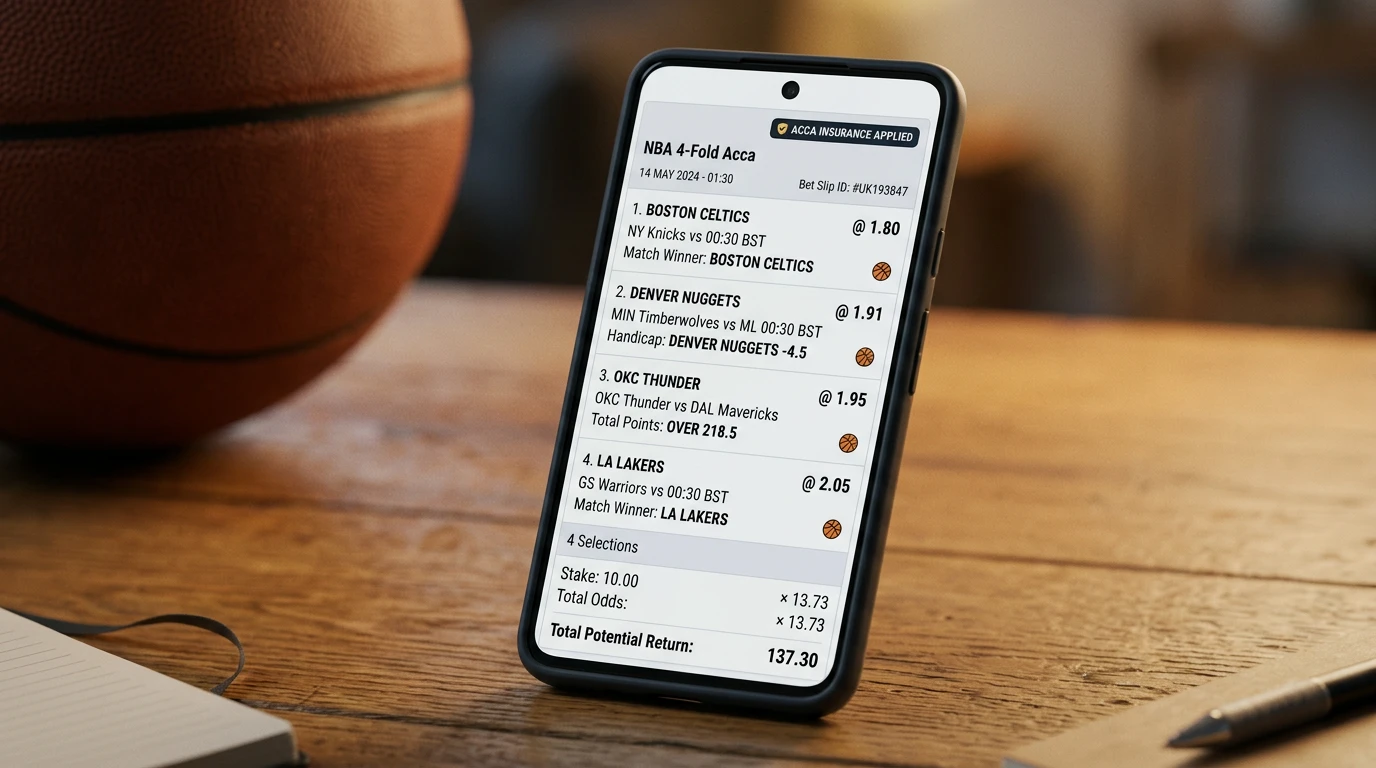
Table of Contents
NBA acca insurance and acca edge promotions are the part of the UK bookmaker product offering that look most generous on the homepage and most fiddly in the small print. The pitches are familiar – get a refund if one leg lets down a five-fold, take a boosted price if you build an acca on tonight’s NBA slate, claim a free bet if your accumulator falls one leg short. Each of those mechanics has a defensible structure if you understand how it actually settles, and a meaningful gap between the advertised value and the realised expected value if you do not. I have watched plenty of UK punters chase these promotions for years without ever auditing the maths underneath them.
The promotional layer sits inside a wider UK betting market that has been growing steadily. Online sports betting now produces 78.47% of all UK sports betting revenue, and General Betting Duty on UK gambling rose from £631 million in 2022-23 to £714 million in 2024-25 – both figures that capture how much money is flowing through the licensed market and how aggressively operators are competing for it. Promotions are how operators acquire and retain customers in that environment, and the structure of the promotions is the most reliable signal of how the operators value different customer segments.
The basketball accumulator promotion most UK punters encounter first is acca insurance – a refund on a multi-leg accumulator that loses by a single leg. The standard structure is straightforward: place a four-fold or larger accumulator, and if exactly one leg lets down, the bookmaker refunds your stake as either cash or a free bet. The mechanic is universal across UK operators, but the specific terms vary in ways that materially affect the expected value.
The single most important detail is the refund format. A cash refund pays your stake back to your account balance, available for immediate withdrawal. A free-bet refund credits your account with a non-withdrawable token that must be wagered on a qualifying bet before any winnings become withdrawable. The free-bet version is worth considerably less than the cash version – typically somewhere between sixty and eighty percent of face value once you account for the requirement to wager it and the variance on the eventual settlement of the wagering bet. A “stake refund” advertised as £25 is rarely worth £25 in real terms.
The qualifying-bet structure is the second material detail. Most acca insurance promotions require minimum odds on each leg – typically 1.20 or higher, sometimes higher – and minimum total accumulator odds. Building an accumulator that qualifies for insurance often requires accepting prices on individual legs that you would not otherwise have chosen, which means the insurance is partially paid for by the inflated prices the qualification requirement pushes you towards. The maths is usually slightly worse than the headline pitch suggests.
The third detail is the cap on the refund amount. Most acca insurance promotions cap the maximum refund at a specific figure – £25, £50, sometimes higher – regardless of how large the qualifying accumulator was. A punter who places a £200 accumulator with a £25 refund cap is insuring only a fraction of their actual exposure, and the implied value of the promotion shrinks as the stake increases. For small-stake recreational accumulators the cap rarely binds; for larger-stake builds the cap matters significantly.
The nba acca edge product is the second category of promotion UK punters routinely encounter. The mechanic is different from insurance – instead of a refund on a losing accumulator, the operator boosts the price on a winning accumulator by a defined percentage based on the number of legs. A typical structure adds something like 5% to the price on a four-fold, 10% on a five-fold, 25% on a seven-fold, and so on up the leg count. The boost applies to the gross return rather than the profit, which means the actual stake remains at risk in the normal way.
The expected-value calculation on an acca edge product is more transparent than on acca insurance because the boost is a straightforward multiplier on the return. A 25% boost on a seven-fold’s gross return adds a meaningful expected value to a bet that is already at heroic odds, but the underlying probability of the seven-fold actually landing is so low that the absolute expected value contribution is small. Acca edge is a high-variance product that adds value at the tail of the distribution rather than across the bulk of the realised outcomes.
Price boost markets sit in a related but distinct category. A bookmaker price boost is a one-off enhanced price on a specific bet or accumulator that the operator has chosen to promote – a same-game parlay on a specific NBA fixture, a player prop combination from tonight’s slate, an outright market with a temporarily inflated price. Boosts can produce genuine positive expected value when the operator has set the boosted price below its true probability – which happens often enough on heavily-promoted markets that audited price boosts are one of the few reliable edges in the UK promotional ecosystem.
The interaction between price boosts and bet builders is worth attending to. Many of the most generous promotional offerings are structured as boosts on specific bet-builder combinations – the operator has constructed the combination, set the boosted price, and is offering it to punters who would otherwise be building their own. The pricing on these constructed builds tends to be sharper than on punter-built combinations because the operator has audited the correlation pricing more carefully. The mechanics overlap with the standard bet builder rules that often interact with acca promos, and the combined product is where most of the genuine promotional value sits.
The framework I use for evaluating any promotional offer is simple. Start with the bet you would place anyway, ignoring the promotion. Calculate the expected value of that bet at the prices on offer. Then add the expected value contribution of the promotion – the refund probability times the refund value, the boost amount times the win probability, whatever the structure is. If the combined expected value is positive enough to justify the bet, the promotion is genuinely valuable. If the combined expected value is still negative or only marginally positive, the promotion is mostly marketing.
The honest answer in most cases is that promotions add some value to bets that would otherwise have been close to break-even, and the value is rarely enough to turn a poor-value bet into a good one. A four-fold accumulator with insurance still produces a negative expected value if the four legs themselves are priced against you, regardless of how generous the insurance terms look. The promotional layer cannot rescue a fundamentally weak set of underlying bets.
The most common UK punter mistake on promotional bets is to chase the promotion itself rather than the underlying value. Operators design promotions to encourage specific betting behaviours – multi-leg accumulators, higher stakes, longer-shot bets – and the punter who optimises their betting around earning the promotional credit usually ends up worse off than the punter who places their normal bets and treats any promotional uplift as a bonus on top. The discipline is to let the underlying value decision drive the bet, and to take the promotional benefit when it happens rather than chasing it.
One specific edge worth flagging: promotions on first-time customers or returning lapsed customers carry expected-value profiles that are systematically more generous than ongoing-customer promotions. The acquisition economics of those segments justify offers that are not available on the long-term customer base, which is why a new account can sometimes capture promotional value that the same person would not see twelve months later. The honest play, however, is to treat that as a one-off rather than a recurring strategy – the operators track customer lifecycles closely enough that systematic abuse of new-customer offers produces accounts that get restricted within months.
The small print on UK acca promotions contains a handful of terms that systematically reduce the realised value below the headline. The void-leg treatment is the first one. When a leg of a multi-leg accumulator is voided – typically because of a postponement or a withdrawn participant – the leg is dropped from the accumulator and the remaining legs continue at recalculated combined odds. For a free-bet refund triggered by a single losing leg, a voided leg in the same accumulator means the structure of the qualifying bet has changed in ways that may disqualify the entire accumulator from the promotion. Read the void-leg clause carefully on any accumulator you intend to insure.
The cash-out interaction is the second one. If you cash out a winning accumulator partway through, the qualifying-bet status for any associated promotion usually voids, which means the refund or boost is no longer applicable. The bookmaker’s interface often does not make this clear at the point of cash-out, and punters frequently realise after the fact that they have forfeited a promotional credit by accepting a cash-out offer. If you have a qualifying accumulator with an active promotion, treat the cash-out option as essentially unavailable unless the small print specifically preserves the promotion.
The third detail is the time limit on free-bet credit usage. Refunds issued as free bets typically carry an expiry – anywhere from seven days to thirty days – after which the unused credit is removed from the account. The expiry creates pressure to wager the credit on whatever happens to be available rather than on the bet that would maximise expected value, which is one of the structural mechanisms by which free-bet refunds end up worth less than their face value.
The fourth and most consequential detail is the qualifying-stake structure on combined promotions. When a single accumulator qualifies for multiple promotions – acca insurance plus acca edge plus a price boost – the operator’s terms typically prioritise one of the promotions and disregard the others, or apply them in a sequence that reduces the combined value below the sum of the individual headline pitches. The promotional stacking that looks attractive on the homepage rarely materialises as a stacked benefit on the settled bet, which is why working through the exact settlement scenario before placing the accumulator is the single highest-leverage piece of promotional due diligence a UK punter can perform.
NBA vs NFL betting is the comparison every UK us sports betting uk punter eventually has to make. Both leagues sit at the centre of US sports betting handle, both…
A reader once sent me a screenshot of a five-leg NBA same-game…
The NBA London game betting cycle in 2026 sat at a strange…
If you'd asked me five years ago what I tracked to know…
