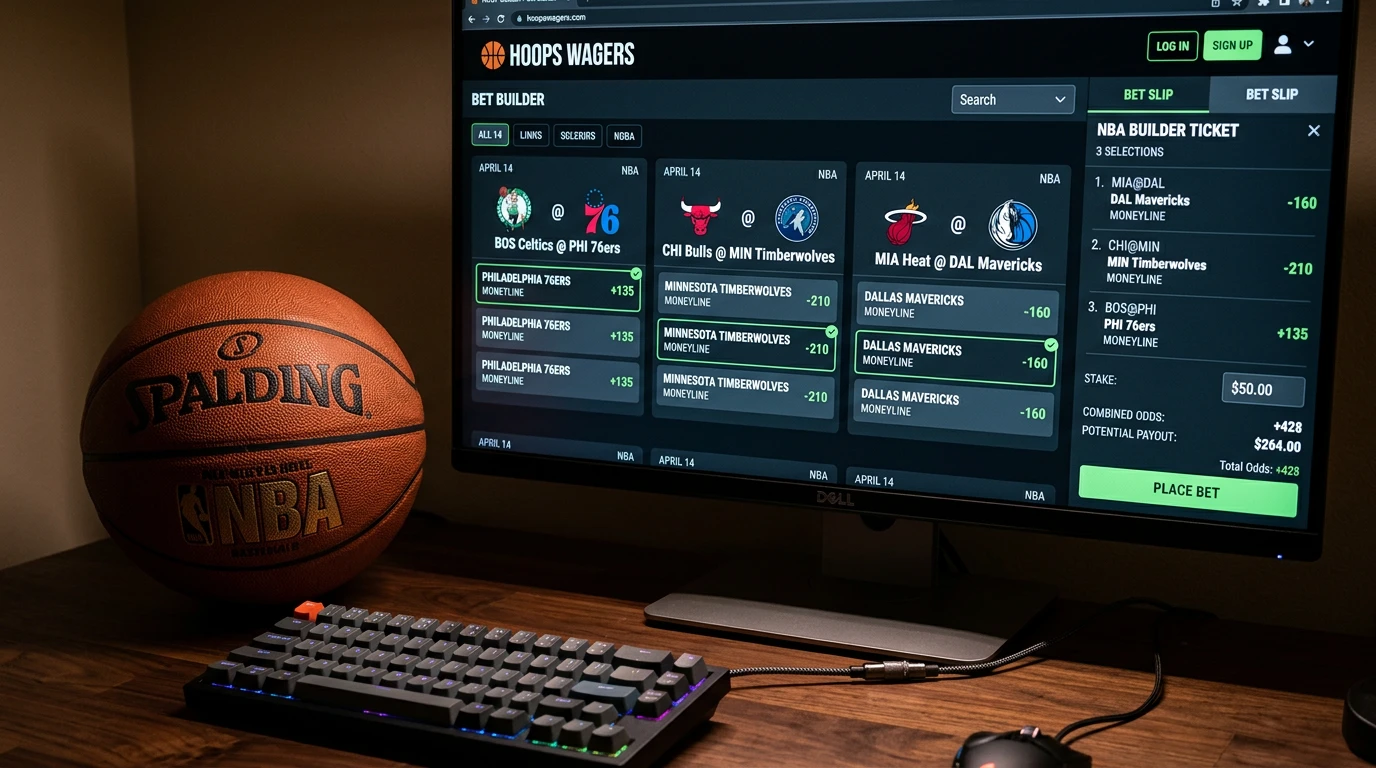
UK NBA Bet Builders: Customizing High-Value Wagers
Create profitable NBA bet builders with top UK bookmakers. Compare custom pricing, explore massive prop markets, and claim your exclusive welcome bonus.
The first NBA bet builder I tried genuinely thrilled me. Three legs, a tidy 7/1 multiplier, and a sense of having outsmarted the bookmaker by stitching together selections that “couldn’t possibly all lose at once”. They all lost. The second one cashed and I felt like a genius. The third reminded me that I wasn’t. Nine seasons later, the bet builder remains the most marketed product in the UK NBA betting menu and the one where punters most often confuse a clever-looking ticket with a smart bet.
A bet builder is a UK operator product that lets you assemble multiple selections from a single fixture – and on some books, across linked fixtures – into one ticket priced by an internal model. The branding varies. Paddy Power calls it “Bet Builder”, William Hill calls it “#YourOdds” depending on the format, and Betfair labels it “Same Game Multi”. Mechanically, all of them combine spreads, totals, props, and team markets into a single multiplier that has correlation baked in.
Bet Builder vs Same-Game Parlay: Comparing Custom Markets
The honest answer to “what’s the difference between a bet builder and an SGP?” is that the line is often blurry, and the UK product naming makes it more confusing than it needs to be.
Both products combine selections from a single fixture. Both reprice the legs against correlation. Both settle as a single ticket where every leg must win. The functional differences come down to three things: which markets are available, how the model handles correlation, and how promotions interact with the price.
UK bet builders typically offer a wider selection menu than US-style SGPs. You can pull in unusual markets like “race to 20 points”, “team to lead at half-time”, first-basket scorer, and combined assists for two specific players. The correlation engine is usually more conservative – meaning it strips a bit more off the multiplier than a pure SGP product would – but it also runs more lenient exclusion rules, so combinations that would be flat-out rejected by an SGP page sometimes go through on a bet builder.
Promotion overlays are where bet builders differentiate hardest. UK operators run boosts, refund rules, and “bet builder of the day” featured multis that pull customers in. Those layers can change the effective price meaningfully, though almost never in the way the marketing implies. The headline number on a promoted bet builder is rarely the no-promo price you’d have got assembling the same legs cold.
Which markets you can actually combine
The available menu on a UK NBA bet builder usually covers six broad categories. Spread, total, moneyline, player points, player rebounds, and player assists. Beyond those, the depth varies a lot by operator. Some bookmakers add player threes made, double-doubles, triple-doubles, first-team-to-score-X, and quarter-by-quarter winners.
What’s often missing – by design – are props on two-way contract players and players on 10-day contracts. The league-wide restriction on “under” props for these players that took effect in October 2024 means UK bet builders inherit those exclusions. If you try to add a prop on a fringe rotation player and the leg gets greyed out, that’s usually why.
Online dominance shapes which markets get prioritised. Online wagering accounts for 78.47% of UK sports betting revenue in 2024, and bet builders are built mobile-first. The result is that the most prominent markets – the ones that surface highest on the operator’s bet builder page – are usually the highest-margin lines for the book. Spread plus star points plus team total is a common stack the operator pushes; the markets that show up further down the menu are often where the price discovery is slightly better.
Quarter and half markets sometimes appear in bet builders and sometimes don’t. When they do, the settlement rules from the standalone markets carry through – quarter and half markets are regulation only, so the bet builder leg will be regulation only too. Don’t assume the bet builder follows full-game rules. Read the leg description.
Boosts, cashback, and how they actually price out
Here’s the truth that most UK guides dance around – boost percentages are real numbers, but they apply to a price that the bookmaker controls. A “30% boost” on a bet builder priced at 5/1 takes you to 6.5/1. That’s better than nothing. The question is whether the unboosted 5/1 was fair to start with, or whether it sat 30% below what an independently-priced equivalent would have offered.
Cashback promos work differently. They typically promise a free-bet refund if one leg lets you down, capped at a certain stake. The effective EV calculation is messy because free bets are worth less than cash – usually around 70% to 80% of face value once you account for the stake-not-returned rule, market constraints, and expiry. A free-bet refund up to £20 on a £50 bet builder ticket is worth roughly £14 to £16 in cash-equivalent terms.
Where boosts genuinely add value is on combinations the bookmaker is actively trying to acquire customers for – usually a marquee Saturday-night fixture or the London Game. The boost is the marketing budget appearing as customer value. On obscure midweek fixtures, “boost” is more often a friendlier-sounding name for an unboosted price.
UK regulatory expectations around promotion design have tightened in recent years. The wider context matters here: industry voices framing what punters should expect from these products vary, with Grainne Hurst of the Betting and Gaming Council noting that “I think there are people who will have problems with their gambling, but that is 0.4% of the population. But I don’t think it’s right to categorise the gambling industry as creating social harms.” Whether or not you accept that framing, the practical effect is that boost terms now have clearer caps and exclusions than they did five years ago – partly because of regulatory pressure, partly because operators have been forced to standardise.
Pitfalls that cost real money
The most common bet builder mistake I see is leg drift. You start with a defensible three-leg ticket, then keep adding selections to push the multiplier up. Each additional leg multiplies the implied probability of failure, and your selection criteria for legs four and five are almost never as strict as for legs one and two. The sixth leg is usually emotional.
The second pitfall is correlation blindness. If you stack star points, star assists, and star threes on the same player, you’re betting one event – that this player has a great offensive game – three different ways. The bookmaker prices the correlation in. Your 12/1 ticket is closer to a 5/1 bet on the underlying event, and you’re paying multi-leg vig to take it.
The third is the “every leg must win” reality. A five-leg bet builder where each leg has a true 70% probability has a combined hit rate of 16.8%. The multiplier required to make that ticket break-even is around 5/1. If the bookmaker prices the same ticket at 4/1, you’re underpaid; at 6/1, overpaid. The arithmetic isn’t hidden, but UK operators don’t show you the implied probability and most punters don’t compute it.
The fourth is failure-to-cash-out anxiety. UK bet builders typically allow partial and full cash-out as the game progresses, but the cash-out value reflects the bookmaker’s margin plus the live market. If four of your five legs have already won and the fifth is still live, the cash-out offer is usually 60% to 80% of the maximum win. Accepting it locks in a known profit but leaves money on the table. The right call depends on your conviction on the open leg and your tolerance for variance. There’s no universal rule – but the bet builder isn’t the right vehicle if you find cash-out decisions stressful. For a fuller breakdown of how UK acca-style promos overlay on bet builder pricing, the promo logic behind acca insurance and boosts piece works through the maths.
Can NBA prop selections be combined into a bet builder?
Most UK operators allow player points, rebounds, assists, three-pointers, and combined PRA props inside a bet builder, with the correlation engine adjusting the price. Two-way and 10-day contract players are usually unavailable for under-style props due to the October 2024 league-wide restriction. Niche props like first-basket scorer and double-doubles are available on some books but not others. If a prop leg greys out as you build, it has either been excluded for correlation reasons or restricted under the integrity carve-out.
Are bet builder boosts always priced fairly?
No. A boost is a percentage applied to a price the bookmaker controls, so a 30% boost on a tight underlying price is worth less than a 10% boost on a generous one. Promotions that look like value on featured fixtures are often closer to fair value once the boost is applied, and unboosted bet builders on quieter fixtures sometimes offer better implied probability than promoted ones. Read the maximum-payout cap, the free-bet refund mechanics, and the qualifying-leg minimum before you treat a boost as found money.