Two-Way Contracts and Why Some NBA Props Are Restricted
A two-way contract NBA betting scenario looks innocuous on a UK punter's screen - a player on the team, a points line, a quick pick. The reason that line is…

Compare NBA and NFL betting markets in the UK. Discover which sport offers the best odds formats, explore prop wagers, and claim your sign-up bonus today.
 Available in US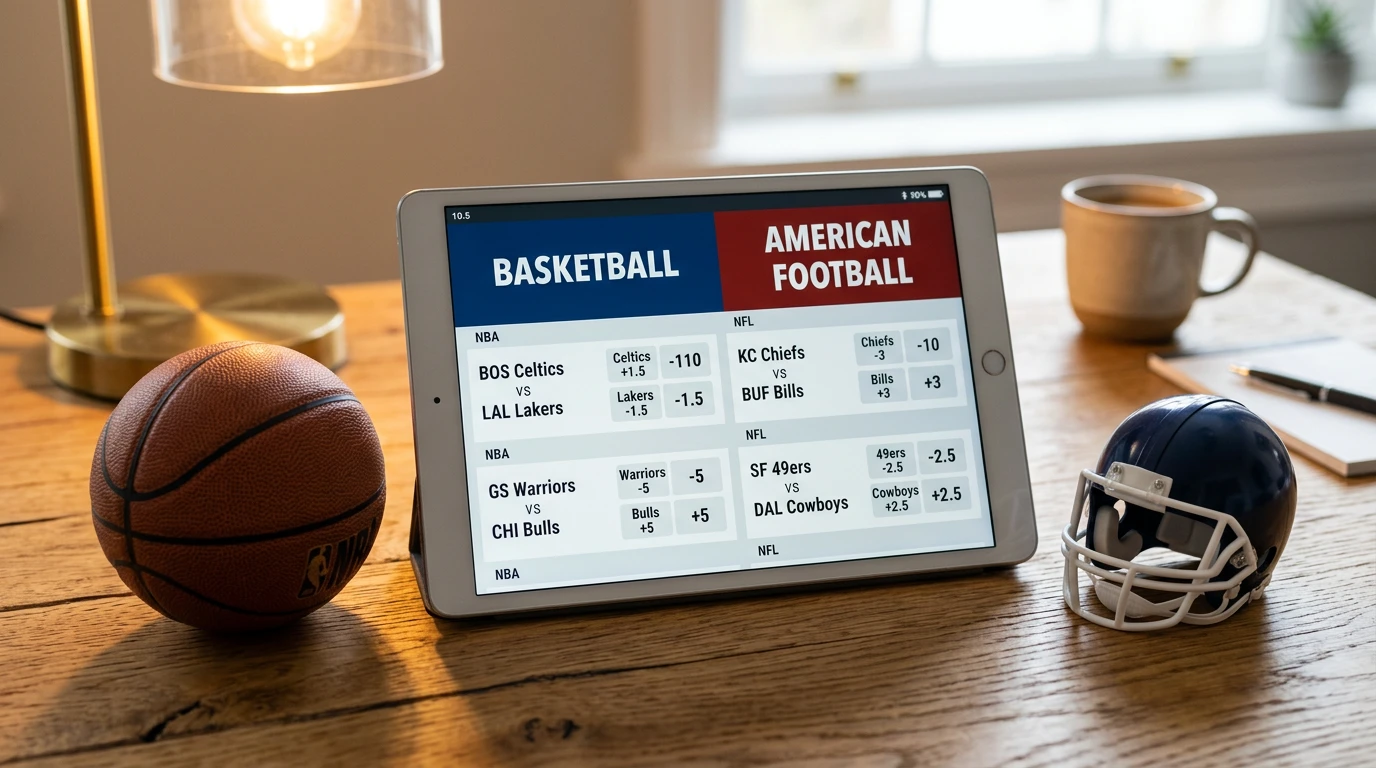
Table of Contents
NBA vs NFL betting is the comparison every UK us sports betting uk punter eventually has to make. Both leagues sit at the centre of US sports betting handle, both draw substantial UK audiences, and both are now mainstream products on every major UKGC-licensed operator. The question is not whether to bet them – most serious UK punters end up touching both – but how the betting experience differs between the two, and which sport rewards which punter temperament. After nine years working through both markets, I have come to think of them as fundamentally different products that happen to share an underlying betting vocabulary.
The handle context tells the scale story. In the US national sports betting market, basketball accounted for roughly 28% of total handle in 2024 – the largest single sport share – while the NFL pulled its own substantial slice across a much shorter season. UK exposure to both products has grown in parallel, channelled through the broader sports betting market that now generates 78.47% of UK sports betting revenue through online operators. The takeaway is that both sports are now genuinely mass-market UK products, and the comparison between them matters for any punter trying to decide where to put their attention.
The structural differences between the two sports drive almost every difference in the betting experience. The NBA is a continuous-play sport – eight quarters of basically uninterrupted action across forty-eight minutes, with possessions changing rapidly and individual plays representing a small fraction of total game scoring. The NFL is a set-piece sport – a series of discrete plays, each preceded by a huddle and a clock reset, with individual plays often representing decisive shifts in the game state.
For betting purposes, this means NBA games have low variance per possession and the cumulative result over forty-eight minutes typically converges towards the underlying team-quality differential. NFL games have high variance per play – a single deep pass, a turnover, or a missed field goal can shift the result by ten or more points – and the cumulative result over sixty minutes is more sensitive to a small number of high-leverage plays. The spread market behaves accordingly: NBA spreads tend to cover or not cover by margins that look proportional to the line, while NFL spreads frequently land on or near key numbers because the scoring system clusters around field-goal and touchdown multiples.
This volatility difference is why NFL half-point moves are more consequential than NBA equivalents. Moving an NFL spread from -3 to -3.5 takes the price across the most common margin of victory in the sport – three points – and substantially changes the implied probability of covering. The same half-point move in the NBA from -4 to -4.5 matters too, but the underlying distribution of NBA margins is broader and the half-point is proportionally less consequential.
The in-play experience reflects the same structural divide. NBA in-play is a continuous trading environment where lines refresh frequently because the underlying game state changes constantly. NFL in-play sits in discrete windows between plays where the price can move sharply on a single result and then stabilise until the next snap. UK punters who prefer the rhythm of continuous markets typically gravitate to NBA in-play; punters who like the punctuated decision-making of one-play-at-a-time markets typically prefer NFL.
UK-licensed bookmakers carry both sports comprehensively, but the depth of the markets differs in ways that reflect the structural game differences. NBA prop menus are broader because the underlying statistical categories – points, rebounds, assists, three-pointers – are continuous across the game and generate prop lines that admit a wide range of bet sizes and combinations. NFL prop menus are deeper on offensive skill positions but thinner overall, because the sport’s discrete play structure produces fewer countable events per game across the roster.
The same-game parlay product behaves differently between the two sports. NBA same-game parlays draw on a high-volume statistical environment where leg correlations are easier to model and a five-leg build can be reasonably priced. NFL same-game parlays carry sharper correlations across fewer underlying events, which both inflates the headline payout numbers and makes the underlying expected-value calculation more variable. UK punters who treat the NFL SGP product the same way they treat the NBA equivalent are usually overpaying for the implied edge.
Futures markets diverge sharply too. NBA futures run across an 82-game regular season with a complex seeding and play-in structure that produces a slow-moving but eventually predictable championship market. NFL futures run across a 17-game regular season with a more volatile seeding structure, a single-elimination playoff format, and a championship market that re-prices dramatically after each round of the postseason. The NBA futures market is more efficient and offers fewer obvious edges; the NFL futures market is more volatile and occasionally rewards the punter who reads a single postseason result correctly.
The headline moneyline markets are the most directly comparable across the two sports. The mechanics, the pricing structure, and the way UK books present the markets are essentially identical, which is why UK punters who learn moneyline betting on NBA can apply the same approach to NFL without significant adjustment. The detailed mechanics of moneyline mechanics translate directly to other US sports almost without modification, and that portability is one of the reasons the NBA serves as a useful gateway for UK punters into US sports markets generally.
The prop bet landscape across the two sports is where the structural differences become most visible, and where the integrity-related restrictions of recent years have hit differently. NBA prop markets have tightened materially since the 2024 Jontay Porter case and the 2025 federal indictments, with US sportsbook partners and UK operators pulling specific “under” markets on lower-tier players and restructuring same-game parlay menus around restricted players. NFL prop markets have faced less restrictive scrutiny, in part because the underlying integrity profile of the NFL has been less actively challenged in the recent regulatory cycle.
That said, the NFL prop market has its own structural constraints. Quarterback-centric props dominate the menu, skill-position props on receivers and running backs sit at a second tier, and offensive and defensive line props are essentially absent. The result is a prop menu that is deep on a handful of high-profile players and thin everywhere else – the opposite of the NBA pattern where most of the rotation has a propable line.
UK punters comparing prop expected value between the two sports find that NFL props on quarterback yardage and completion totals have historically been some of the highest-margin markets in the UK book offering, while NBA props on points and rebounds for star players have been some of the lowest-margin. The contrast partly reflects the differing volume across the markets and partly reflects the structural advantages NFL bookmakers have in pricing a quarterback’s yardage line, which is supported by deeper statistical modelling than the comparable NBA scoring prop.
The shift in prop pricing on the NBA side following the integrity events of 2024 and 2025 has narrowed the historical margin gap. NBA prop pricing has tightened defensively as books have applied stricter risk controls, while NFL prop pricing has continued to operate within its established framework. The result is a 2026 betting environment where NBA prop margins are tighter than they used to be and NFL prop margins are roughly where they were two seasons ago – a convergence that has not yet fully worked through the UK market consciousness.
The temperamental fit between punter style and sport is genuinely meaningful, and it is something I think UK bettors underweight when they first start betting US sports. The NBA rewards punters who like continuous trading environments, frequent decisions, and the rhythm of a 1,230-game regular season where individual games are rarely make-or-break. A punter who enjoys placing four or five bets across a Tuesday-night slate, who likes watching pace and rotation patterns develop across a series, and who is patient with closing line value as the long-term measure of skill, typically thrives on NBA betting.
The NFL rewards a different temperament. The 17-game regular season produces fewer betting opportunities per week, individual games carry more weight in the season-long arc, and the single-elimination playoffs produce moments of enormous variance that test conviction in ways the NBA playoffs rarely do. A punter who enjoys deep weekly preparation, who is comfortable with high-variance results on a small number of bets, and who finds satisfaction in calling the outcome of a discrete weekly slate, typically prefers NFL betting.
The right answer for most UK punters is to do both, but to weight them differently. The NBA produces enough betting volume to be a primary product for any committed US sports bettor, while the NFL produces a higher-stakes weekly cycle that complements the longer NBA rhythm without competing with it. The two seasons overlap from October through February – peak intensity for both – which is when UK punters serious about US sports markets spend the most attention and place the most bets. The remainder of the calendar belongs to the NBA alone, which is one of the structural reasons the NBA serves as the base product around which most UK US-sports betting routines are built.
A two-way contract NBA betting scenario looks innocuous on a UK punter's screen - a player on the team, a points line, a quick pick. The reason that line is…
I've been burying small futures positions in NBA championship markets for nearly…
The first time I cashed out an NBA bet I felt clever…
The first time I cashed a UK NBA point spread ticket, the…
